Mostrando entradas con la etiqueta Microsoft. Mostrar todas las entradas

sábado, 13 de octubre de 2018

Summary of Seven Days

This is a quick post to list the latest events.

1.  Mageia 6.1 was released six days ago (Oct 6).  I was sick and busy and, because of that, I missed the announcement.  I do not need to install it on my computers, but I will download it to install it on my daughter's machine and fix the problem with the MCC.

2.  Google+ is being killed (Oct 9).  That marks the end of my 3-year experiment with this social network.  Wow, excluding Blogger, that was the only social network in which I have been active for more than a year... I tried Tagged, Hi5, Facebook (before it became so popular here), and YouTube. Right now, I have been looking for a replacement and tried MeWe and Pluspora... MeWe is too Facebooky for my taste.  Pluspora feels like a merge between Facebook and Twitter with limitations and a really geeky flavor.  I guess I will continue my test drive in Pluspora for a while.

3.  Microsoft and the patents (Oct 10).  Megatotoro shared this article with me.   I was confused.  Either Microsoft is changing its position or it is a masked move that, in reality, does not help Linux at all.  Which one will be, I wonder?

4.  My Fedora acted weird (Oct 11).  As I was attempting to update Fedora, some WINE-related packages were not found because the repos were absent.  I updated without them and the screen locker got broken.  I had encountered that before in OpenMandriva, so I switced to a virtual terminal with Ctrl+Alt+F2, logged in with my user and password, and then executed loginctl unlock-session 5.  Then I switched back to the running session with  Ctrl+Alt+F1.

5.  The Forest on Steam via WINE ate up my home space (Oct 12).
I was playing this Windows game on Fedora using the Windows Steam client via WINE.  It works fine, but then the system told me that I was running low on space.  I checked with Dolphin and I had only 340Mb free!  After a while, this number went down to 467Kb.  When I finished the game, I rebooted and my free space came back.

miércoles, 18 de noviembre de 2015

The Astoria Dilemma... in Images!

These last weeks have been pretty stressful.  So, taking a break form my work, I decided to do something to take my mind off of everything....


lunes, 16 de marzo de 2015

Let Users Bear the Burden of Updates: MS Latest Windows 10 Idea

I read this article today.  Apparently, Windows 10 users will be able to choose if they want to grab updates from PCs over a private network or, more disturbingly, from the Internet.

To be honest, I don't know why the author thinks users will love this P2P "feature".  All he worries about is the --very real-- potential risk of hackers getting new toys to play with.  However, I think he missed a very significant point, one that affects clients directly.

With this P2P updating idea, Microsoft can put the burden of the downloads away from its own servers (where it should be located) and re-locate it on the machines of its customers.

This means that the customer's PC will become slower as it will serve the updates to another client.  And who pays for the upload?  If my machine is uploading, it is using the internet connection that I pay for.  In other words, I am not only letting Microsoft use my machine to relieve the burden on its servers, but also letting this abusive company use my internet connection for free.


"Yes, Microsoft, come use my resources with no benefit for me and, while you're at it, please charge me a yearly (maybe monthly) subscription to use my own computer!  I will love that!"

What kind of a deal is that?  Why should Windows users be happy about it?

The only thing I am happy about is that I DO NOT USE WINDOWS, so that this abusive company cannot reap me off so shamelessly!

jueves, 6 de noviembre de 2014

Microsoft finally got it correct

Some months ago, I visited a Microsoft site to see if it could identify my OS correctly.  I am a Linux user and the site identified my computer as a device running Windows 8.

I do not think that it is so difficult to identify the OS of a computer correctly.  I mean, this site can do it pretty accurately.  Was that a careless mistake on Microsoft's part?  Is it possible?  Or was it a poor strategy to report larger figures for Windows 8 market share?

Whatever the case, everyone knows 8 was a disaster and 8.1 did not help much.

Anyway, after all this time, I visited the MS site again and, to my surprise, it can now see me as a "non-windows user" :P  Wow!  I call that improvement!

Finally, Microsoft says I am not running Windows
To show my appreciation, I took the time to fill up the survey and evaluate the site.


sábado, 8 de octubre de 2011

Why I failed the Windows 8 Logo Program

With all this uproar because of the implementation of UEFI as a requirement for the Windows 8 Logo Program, I decided to apply to get it because of the advantages it offers. You know, I tend to boot up rather slowly in the morning: I walk around my house in a state of semi-consciousness until all the proper drivers and modules are loaded. It would be great just to wake up and boot up into my operating system in the blink of an eye.

I discovered that one of the requirements to apply for the Windows 8 Logo Program, before I boot up, is to have secure boot enabled by default. I also must carry several sets of keys, all for the sake of prevention. According to MS, if I do not, some malicious thoughts could hijack the boot process and then I would be cast into a zombie state, controlled by some criminal or terrorist. Thus, I might end writing and sending millions of useless postcards...That's scary, isn't it?

So, the basic idea, protection from criminals, sounds appealing. Yet, I started asking some questions and found some problematic issues hidden below the surface of the venerable claim of security:

1. The keys and what you wear

The keys that they give me allow me to boot up super fast because they restrict the elements that I need to function. For instance, I will save time getting to work because I won't have problems remembering where I left my glasses the night before. What's more, in theory, even if a malicious poltergeist wants to play with my eye-prescription device, the mischievous spirit won't be able to. However, there is a big problem with this approach depending on who provides the keys. Let us suppose that MS allows OEMs (Organism Evaluating Mechanisms) to provide their keys. The control on what I boot up into will be so tight that if I, by any chance, want to wear a pair of glasses that is not certified by the key that they gave me, I will be treated like the poltergeist myself. Yes, I'd be in trouble to change my shirt, too. This will make a uniform world, indeed. I'm surprised that the United States, a country that defends individual rights with a passion, might meekly agree to let everyone use "the same clothes". Everyone into the same school uniform! How about that?

But the most worrisome part comes next...

2. Secure boot and the right to think

The fact that I cannot choose my glasses manifests something important that is underlying this prohibition disguised as "prevention". If this so called "secure boot" will not let me swap glasses or shirts easily (action), my right to consider wearing some glasses other than the certified ones (thought) is taken away from me. That is, I cannot even think about wearing anything else... Not even the widely-used MS XP Professional SP3 Glasses, for example. Paradoxically, I won't even be able to replace my MS 8 glasses (OEM version) by a brand new a pair of boxed MS 8 glasses if the keys are given by an OEM and not MS itself. You see, my individual right to think about choosing what I want simply ceases to exist.

You might think that all this is simply solved by disabling secure boot. You are, of course, absolutely right; I also thought that way. And that's the reason why I failed the Windows 8 Logo Program: you must have secure boot enabled BY DEFAULT to apply, remember?

I guess I value my freedom more than the Logo. In the end, if I'm free, I can take care of my security myself.

----------------------------------------------
On a serious note, next time I need to buy a computer, I'll make sure I'll purchase it from a manufacturer that respects my freedom to choose.

sábado, 1 de octubre de 2011

On the University migration to Free Software

Megatotoro described here how the recently announced University migration to free software made a big splash in national newspapers and even on TV news. The idea is to start by replacing MS Office suites by free software equivalents (Open Office.org/Libre Office) and, eventually, dump Windows and implement Linux.

I visited the online page of one of those newspapers to see the coverage and the comments I read were, for the most part, very encouraging and positive. Of course, the public is congratulating the University for the initiative of saving a LOT OF MONEY (that was used to pay MS licenses) through the use of Free Software and to invest this growing amount on improving the campus and on resources available to students.

Today, I had the opportunity to speak to the Dean of the Faculty where both Megatotoro and I work and somehow the conversation steered to Linux. To my surprise, she said: "So you use Linux? That's where we are heading!". Her position was one of embracing change rather than one of fear or discomfort.

Her words are certainly consistent with some actions that the University took:

1. A Free repository was enabled, so scholars and researchers can upload their works and share them with national and international communities for free

2. Several University dependencies have taken measures to guarantee access to their services from different platforms, Linux included.

3. There is a cluster of servers called ESPEJOS (mirrors) that basically lets people download linux distros and other free software from everywhere.

4. The ICT programs are required to teach courses on Free Software.

When the reporters asked the MS representative that handles government issues in the region how Microsoft was affected by this, her words were more an evasion than an answer. She said that Microsoft is “commited to work on interoperability”, and that “this implies more opportunities for developers and more technological innovation and market competition for enterprises and governments, and users”.

Yes, interoperability, she said. For crying out loud! It's thanks to Microsoft that their own proprietary formats do not work properly with other office suites (sometimes, not even their own!)

The interesting outcome of all this is that many comments from the public are urging the government to imitate this step the University took. Of course, our country is not rich and sending all that money to Microsoft instead of investing it on our students or services makes little sense.

I'm sure Microsoft will try to react to this. I was told that, last time, they had a terrible flop trying to license a specialized software for statistics in Windows...It was embarrassing because, during the demo, it crashed, just like on this memorable video...

Maybe that episode prompted the migration :-)

miércoles, 22 de junio de 2011

A no-OS-computer? You must be a pirate!

After reading this piece about a
Linux keyboard PC , I got excited. I've been looking for a nice computer that is sold without any operating system so that I can install my own. Yes, I'm aware of the existence of System76 (Ubuntu systems) and ZaReason (several Linux offers), but I wanted to try something else. Thus, I checked the vendor's page and, sure enough, there was a "NO OS" option. With a high heart, I selected the components of the system and submitted my request waiting to receive the quote with the price.

A day later, I received it and, with it, there came a surprise. The price was satisfactory ($555), but they had included Windows 7 Professional 32 bits and were charging me for it!

I immediately contacted the sales representative to ask why they were forcing Windows on me if I had explicitly selected a "No-OS system"(I changed the names):

Dear Sales Representative,

I have one question concerning the quote. Why are you including and charging Windows 7 if I explicitly selected the "NO OS" option? Can you sell it without Windows? I am not interested in paying for Microsoft software; I only want the computer.

Regards,

Mechatotoro

This was her answer, which I found rather strange:

Hi Mechatotoro,

We can sell the unit without the OS provided you do have OS licensing. I included the pricing info for the OS so that you can deduct the $176.00 price point if you do not need one included which would make the price $379.00. Attached is the revised quote.

Please let me know if you have any additional questions.

Best Regards,

So, she said that she had done it because, that way, I could deduct from the price the cost of Windows (?!) as long as I had "OS licensing".

This showed to me that, thanks to Microsoft's dirty campaigns, you are seen as a pirate when you request a computer without any OS. Is it so unbelievable that a customer does not want Windows? So, I replied to her:

Hi, Sales Rep,

I am a Linux user and plan to install Linux to the computer. Consequently, your point about licensing (Microsoft license, that is) does not apply in my case. Your offer seems very attractive. Thanks.

The good thing about this exchange is that I could do the math. If the price of the No-OS unit is $379 and Windows 7 costs $176, that means that Microsoft software accounts for almost 50% of the price of the system (46%)! From $555 to $379 for exactly the same computer...That is a considerable difference!

Another interesting point is that OEMs, companies that work with HARDWARE, not SOFTWARE, are actually doing the dirty work for Microsoft. If piracy affects the Redmond software vendor, it should be the one checking for licenses and doing the police work, not OEMs. I wonder how Miscrosoft is going to keep up with the abusive idea of the MS tax. Can they still bully OEMs assuming that No-OS necessarily implies Windows piracy? Can they get away with it in a world in which we see multiple OSs and users are aware of this today?

So, OEMs think that I'm a pirate because I don't want Windows? That's fine with me, really... Just give me the option NOT to buy Windows and we call it a deal!

UPDATE: The sales rep got back at me and said I can buy. It seems that I am on the clear now. Great! :-)

sábado, 28 de mayo de 2011

If Microsoft made Linux

Jokingly, I imagined what Linux could be like if Microsoft developed it.

My dear Windows ME, now as Linux ME!


How about Windows Longhorn that never was? VISTAAAA! Yes, this is Linux Vista in all its glory!


And this jewel? Linux Vista/7 Starter edition!

viernes, 15 de octubre de 2010

I know how to use Windows properly, so it's not my fault!

"I know how to use Windows properly, so it's not my fault."

With that declaration and the particular stress on the possessive adjective, Mr. Valmers started his testimony before the inquiring eyes of a judge and the jury members, who began whispering and shaking their heads in disapproval. They had listened to the technical report of a software expert before the afflicted average computer user sat in front of them.

Sensing the effect that his initial words had on the atmosphere of the room, Mr. Valmers paused timidly and cleared his throat before the microphone, causing listeners to tilt their heads for a second that became awkwardly long. Pierced by the prying eyes of the prosecutor, the fifty-something owner of an infected PC wished he could have uttered something like: "I know how to use Windows. I took courses to learn how to use my Windows computer, you know, so do not patronize me, techie." However, he just sat there, mute, as a target for the questions that, sooner or later, would dart from the mouth of the implacable man in front of him.

Mr. Valmers thought for a second. How could he prove that he did nothing wrong according to what he learned in those Windows courses he took? In spite of the fact that the expert had made it clear that such action was a pre-requisite for a secure Windows computer, no instructor had ever told him that he was supposed to disable autorun. Darn pedantic guy! But then, why was it that the stupid autorun feature was enabled by default in Windows if it was so dangerous? Mr. Valmers had done what he was told in four courses to be safe from malware: he bought an expensive antivirus (what a poor investment!), he had that software installed along with MS Security Essentials, and he made sure that the Windows firewall was on as he browsed the Web. Religiously, the man had downloaded antivirus updates and the traitor software never gave a warning of the infection that had him sitting as a fool in front of all those people that looked down on him.

"This is not fair," he heard himself say, "if autorun is so dangerous, or Windows is insecure, I am not to be blamed. I did not do anything to make my computer any more vulnerable than it was when I bought it."

How he wished that Microsoft's CEO, that bad-tempered bald guy, had been there in his place! This guy was actually the one who was responsible for all computer infections...He was the careless person that approved the release of such a defective product for mass consumption!

"It was your negligence that caused the infection. It was your computer, Mr. Valmers, which was spreading viruses to several Government institutions," charged the prosecutor, assuming a stance of superiority. "Your computer," he stressed with poorly-concealed satisfaction.

The possessive adjective lingered for an additional second on the thick air of the room and echoed inside Mr. Valmers' head. "Your computer, your computer," repeated a hypnotic voice while the man felt as an insect pinned on a wall.

All of a sudden, that simple four-letter word opened his heart with hope in a Joycean epiphany.

"Yes, sir, it was my computer," he replied. "But, according to the EULA, Windows is not my software. I do not own it. I did everything in my power to secure my computer, but I cannot do anything to improve the condition of the software".

Murmurs of the listeners grew until they became a tidal wave of noise that forced the judge to demand silence... (to be continued)

------------------------------------------------------------------------------------------------------------

Yes, this is a piece of fiction I am working on. However, it can turn into a reality if people are dumb enough to accept Microsoft's newest trickery: a call for banning sick computers from the Internet. Read about it here.

Microsoft Windows 7 Starter EULA and customer abuse

Today, as I was reading this post, I decided to pay Microsoft a visit and download a copy of their glittering Windows 7 Starter EULA. I read some requirements that unsettled me. Let me transcribe an excerpt of the Windows 7 Starter EULA to tell you why those conditions are simply outrageous:


"By using the software, you accept these terms. If you do not accept them, do not use the software. Instead, contact the manufacturer or installer to determine its return policy. You must comply with that policy, which might limit your rights or require you to return the entire system on which the software is installed [...].

You may use the software as expressly permitted in this agreement. In doing so, you must comply with any technical limitations in the software that only allow you to use it in certain ways. You may not
  • work around any technical limitations in the software;
  • customize the desktop background
  • reverse engineer, decompile [...]
Certain features of other Windows 7 product editions, including Windows Aero and the ability to change the desktop background, are not included in this software." (Microsoft Windows 7 Starter EULA)

I doubt that Microsoft lawyers seriously expect users to comply with those ridiculous terms and conditions. First, an interesting tautological falsehood is created if you must accept the software (Windows 7 Starter) with all its flaws and the license forbids you from "working around technical limitations". If you accept the conditions of this EULA and take Windows vulnerability to malware as one of the implicit "technical limitations in the software", the logical implication is that the EULA itself forbids you to install an antivirus solution to protect your Windows system. Of course, lawyers will claim that the clause refers to improving the OS itself, not "helping it" with additional software. However, the contradiction lies on the fact that the EULA makes the OS and the system an indivisible unit (remember: you must return the computer if you do not accept the license). Therefore, if hardware (tangible, made by an OEM) is ridiculously bundled with software (intangible, made by Microsoft), why would they claim that other software running on the OS to protect it is not an indispensable part of the system? Because it is third-party software, not Microsoft's, they will probably say. Well, how about the hardware the OS is running on? Is not that third-party, too? Why is it that I must return the hardware if I reject the software (Windows), then? After all, the hardware was not made by Microsoft. I suppose that Microsoft representatives would say that it is because the OEM agreed to install Windows. If that is the case, then the OEM should be required to agree to the EULA, not the computer buyer.

The situation, however, becomes even more ridiculous with the second clause. The statement is categorical; there is not any ambivalence to it. I guess you can even rephrase it as a biblical commandment: "Thou shall not customize the desktop background".

Basically, dissatisfied people who found third-party programs to change the hideous Windows 7 Starter background are against the law. Yes, they are violating the Second Law of Microsoftics. Period. There is no argument about it. Nevertheless, I do not see Microsoft's legal war machinery aiming its weapons at them. Why not? Well, because the progenitors of the unpopular 7 Starter knew from the beginning that sober people would never comply with such buffoonery and that other software companies would palliate the situation which, in the end, saved Microsoft's face (yes, Starter seems to be a rival for Clippit's unpopularity). That is why the Redmond bully never filed a lawsuit against Oceanis, for example, even though the latter company produced a program designed exclusively to make users break the "unalterable background" law.

Interestingly, Microsoft's failure to launch an attack to force users respect the content of the Windows 7 Starter EULA spawns yet another contradiction: Can this permissiveness be taken as a signal of amnesty toward infringement? If so, then the whole content of the EULA goes void, which means that I can pirate Windows 7 without any concern. But you know how this would end: Microsoft lawyers would not hesitate to take me to court if I do.

I wonder what would happen if people realized how anti-democratic these EULAs are. Not only do these irrational licenses cut your freedom, but they also establish discriminatory policies against users who "rebel" against them. This looks more like fascism than anything else to me. (The image was censored because it depicted inappropriate content for Microsoft, I suppose. After all, any visual connection that you make between this company and fascism is perceived as such regardless of the clearly anti-democratic practices the company promotes. What attribution does this company have to "limit my rights" as an individual and transfer the execution of this violation to OEMs?)

domingo, 5 de septiembre de 2010

A prickly questionnaire

When people see my OS, they always ask the question "What version of Windows is that?" I answer that I use Linux and most of them look at me as if I had spoken a word in some sort of an alien language. Then, afer I tell them what Linux is and what it can do, most of them give me a funny look, that funny look, as if I were delusional.

I understand that people feel comfortable with Windows, despite the fact that this OS has a talent for hiding or corrupting files, failing to rescue documents, getting all sorts of infections, and "upgrading" to mostly cosmetic features instead of significant ones. After all, under Windows, you can bloat the computer with third-party software to patch holes or obtain the benefits that an OS should give you...or, at least, to try to get very close to that.

However, without third-party solutions, Linux can rescue your files, even when Windows gives up on you. Read this. In addition, Linux has a price that is difficult to beat , and its learning curve has been grossly exaggerated.

I created this questionnaire (based on my experience with Windows) to ask back to those people who think that Linux was not a good idea for me. Maybe, this is going to explain my choice more clearly to them.

A Questionnaire for Windows Users--from an ex Windows user

1. When was the last time that Windows succeeded at rescuing your files?

2. Was the need to rescue files derived from a virus infection, a hacker intrusion, or a normal crash of your OS?

3. Do you truly think that your OS crashes should be considered "normal"?

4. What OS were you using last time you got a virus in your computer?

5. If your antivirus detects a virus but can't remove it...do you know how to remove the threat manually?

6. If you do... Is that an easy process that you can repeat in exactly the same way for all viruses?

7. How long does it take to remove a virus (in average) using your AV software?

8. And without it?

9. Are you happy when you add up the cost of the OS, the office suite, and additional security software?

10. Do you pay for all that?

11. If you pay for your OS, do you do it because you are entirely satisfied with the product, because you are a loyal costumer, or because you have no choice?

12. If you did not pay for your OS, are you a proud pirate?

13. Would you like to get a legal suit from an economically-powerful software company?

14. What would you do if you got one from the company that makes your OS?

15. If you pirate not to pay for software...don't you think that using only free software makes more sense?

16. When was the last time you had to pay for your hard disk to be formatted and your OS to be reinstalled?

17. Do you feel satisfied calling formatting and reinstalling "regular maintenance operations"?

18. If you install your OS yourself...how long does the process take?

19. Did you include the time for the office suite and all the programs that you like in your answer for #18?

20. Do you have any guarantee that the next version of the OS you use will support your printer, scanner, and other hardware?

21. How about the files you made with the office suite you paid for? Will those be supported, or are you going to be expected to buy a new office suite?

22. If you consider carefully your answers for #20 and #21, do you think that the company that makes your OS really cares for your needs as a costumer?

23. If you understand that the company wants to make a profit at your expenses and it overlooks your needs, why do you support it with your money and why are you even willing to pay others to solve the problems that the company's products create?

24. If your answer was "because there is no choice", you know there are other choices. If fact, you are seeing one. Why are you brushing off the question?

25. How much more are you willing to take in the name of your OS? Let me rephrase that, "What does it take for you to try other choices?


I asked myself all those questions a year ago and that explains why I am using Linux today. Of course, I had to learn to operate this new OS and I made mistakes. However, in all this time, I haven't had anything that resembles--even remotely-- all the problems I had with Redmond's OSs. Nothing justifies all the money and time I wasted with Windows in 11 years.

One thing is sure: when my Linux computer finally stops working, at least I will know that my OS did everything possible to keep it alive. Windows, on the other hand, just tells you that your computer is not "good enough" to run the OS. But I learned that, for Microsoft, no currently available computer is good enough to run the latest version of Windows anyway. Mark my words: your nice computer running 7 today will be "obsolete" by the time Microsoft releases Windows 8. However, we know that, although some of the hardware might have become "older", what is actually obsolete for the Redmond software company is their OS, not the computer itself. And they have no regrets about spending any amount of money to fool you into believing that your hardware is to be blamed!

sábado, 3 de julio de 2010

Nueva brecha de seguridad en Windows: Microsoft

¡Windows XP se encuentra en este momento BAJO ATAQUE! Pero no se preocupen. Microsoft les brindará apoyo...¿O tal vez no?

Mucho se ha dicho sobre por qué Linux is inherentemente más seguro que Windows. No obstante, después de leer este post (del 1 de julio, 2010, en inglés) de PC Advisor, me percaté que, hoy, los problemas de seguridad en Windows pueden estar siendo promovidos por Microsoft. De hecho, la política de seguridad de la compañía tiene más que ver con el modelo de negocios de Microsoft que con su apoyo a los clientes.

Mientras los usuarios de Windows XP le confiaron la seguridad de sus equipos al emporio del software, que prometió brindar apoyo para XP hasta 2014, la peculiar respuesta de Microsoft para resolver el problema revela varios hechos interesantes.

1. Microsoft recibió la información con bastante anticipación, pero permaneció relativamente en silencio hasta que el problema se dio a conocer públicamente y fue explotado a gran escala. ¿Por qué razón Microsoft no se apresuró a corregir la situación? ¿Fue acaso falta de interés? ¿O por intereses en conflicto?

2. Microsoft le dijo a los usuarios el 10 de junio que ellos mismos deberían resolver el problema y publicó en línea un "manual" para este propósito. Es importante hacer hincapié en que el problema se encuentra en el Centro de Ayuda y Apoyo de Windows, que es un servicio automático que los usuarios promedio no pueden controlar. Con el fin de corregir el desperfecto, se esperaba que los usuarios hicieran el trabajo sucio de edición del registro de Windows. ¿Por qué la compañía le dio la posibilidad al usuario de entrar al registro y desordenarlo? Abrir esa puerta implica, para la mayoría de los usuarios, correr el riesgo de arruinar sus sistemas. ¿No le corresponde a Microsoft corregir el problema? ¿O acaso la compañía varió su política y ahora trata de "educar" a los usuarios de Windows en cómo operar las entrañas de su sistema operativo?

Me parece que esta situación pone de manifiesto cuánto le importan a Microsoft sus leales usuarios. La gente enciende su computadora confiadamente, sientiéndose protegida por el gigante de Redmond. El mensaje no es tan difícil de comprender: MICROSOFT DESEA QUE ATAQUEN A LOS USUARIOS DE WINDOWS XP. La compañía quiere, estimado usuario de XP, que a usted lo ahoguen los virus y los problemas. De esta forma, cuando usted busque una solución, probablemente será usted mismo quien genere más conflictos en su sistema. Usted morirá por su propia espada.

Claro, todo lo anterior lo llevará a pagar por Windows 7, que incrementará las ventas de dicho sistema. ¡Admirable modelo de negocios es éste que Microsoft ha creado! Qué mal que, dentro de este paradigma, vender un sistema operativo es más importante que brindarle seguridad o apoyo a los clientes.

Puede que los usuarios de Windows 7 sonrían y piensen, "A mí no me importa. Yo uso Windows 7 de todas formas." Bien, eso es absolutamente cierto. Sólo espero que usted pueda permanecer con tanta confianza una vez que Microsoft ponga a la venta Windows 8.

Y la gente aún duda de usar Linux...

viernes, 2 de julio de 2010

New Windows Security Breech: Microsoft!

Dear Windows XP user, listen:

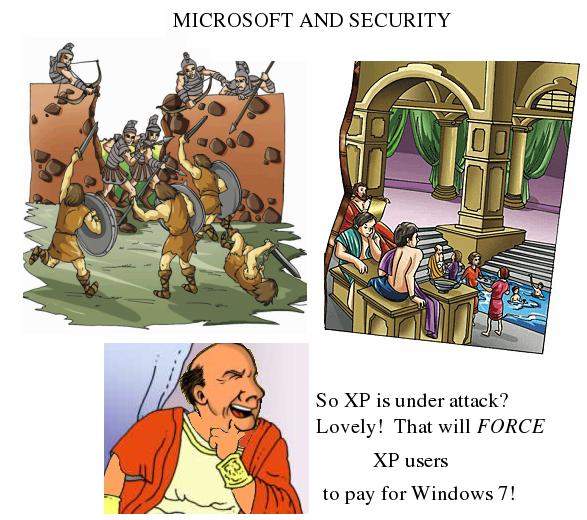
Windows XP is NOW UNDER ATTACK! But don't worry. Microsoft has got your back...Or maybe not?

A lot has been said about why Linux is inherently more secure than Windows. However, after reading this post (dated July 1, 2010) from PC Advisor, I realized that, right now, the security problems in Windows can actually be promoted by Microsoft. In fact, the security policy of the company has to do more with its business model than it does with costumer support.

While Windows XP users entrusted the security of their systems to the software emporium, which vowed support for XP until 2014, Microsoft's peculiar response to fix the problem reveals certain interesting facts.

1. Microsoft got the information way in advance, but remained relatively silent until the problem was disclosed and exploited publicly. Why didn't Microsoft hurry to correct the situation? Lack of interest, maybe? Or conflictive interests?

2. Microsoft told users in June 10 that they had to fix the problem themselves and released a "manual" for that purpose. Now, the problem was found in Windows Help and Support Center, automatic services that average users normally cannot control. To solve the issue, users were expected to get their hands dirty editing the Windows registry. Why was the company asking users to mess up with the registry? Doing so implies, for most Windows users, running the risk of actually destroying their systems. Doesn't Microsoft have the obligation to correct the issue in the first place? Or is it that the company switched policies and is now "educating" Windows users on how to dissect their operating system?

I believe this shows how much Microsoft cares for their loyal Windows users, who turn on their computers with confidence, feeling protected by the Redmond giant. The message is not so difficult to grasp: MICROSOFT WANTS WINDOWS XP USERS TO BE ATTACKED. They want you, XP user, to be victimized by viruses or exploits. This way, when you look for a solution, you are likely to inflict more damage to your system yourself. So you die by your own hand.

All this leads you to end up paying for Windows 7, which will certainly give Windows 7 sales a boost. What a nice business model Microsoft has created! Too bad that, in this paradigm, selling a new OS is more important than either security or support for costumers.

Windows 7 users might grin and think, "I don't care. I have 7 anyway." Well, that's absolutely true. I hope you can remain as confident once Microsoft releases Windows 8.

And people still hesitate to use Linux...

viernes, 18 de junio de 2010

Microserfs and the Future of Microsoft

I started this interesting novel by Douglas Coupland. The book is entitled Microserfs and it manifests Geek culture by depicting the lives of several coders who work for the software giant in Redmond. Along with the movie Pirates of Silicon Valley, in which one can see the origins of Microsoft, this book has given me a lot to think about...and I am only on page 40!

The novel shows how MS employees developed a certain "Microsoft culture" that happens to be very interesting. Of course, corporate culture is nothing new, but there are certain factors that acquire an undeniable notoriousness (not to mention a somewhat prophetic glow) when one considers that the book describes the reality of the 90's.

The first factor that I saw is the omnipresent figure of Bill Gates (B-B-B-B-B-B-I-L-L!) that gravitates in the minds of the characters and determines their motivations and actions: They walk in certain way if they believe that B-B-B-B-I-L-L is watching them; Bill's biomass becomes a separate category on MS Campus (19% humans, 0.003% Bill), and they feel both depressed and honored when they get a scolding email from him, to illustrate. This made me think about what Microsoft is today, a feudal land without the lord everyone admired.

I must admit that the leadership of Bill Gates has turned him into a mythical creature, just like a unicorn or a pegasus. True, there are tons of Gates jokes around, but, in general, I get the impression that Gates is treated kindly. I mean, he is caricaturized and everything, but his eternal Geek aura has protected him from vicious graphic representations, even after the disastrous release of Windows ME (Millennium Edition, jokingly nicknamed "Mistake Edition"). I understand that the last Windows project he was involved in was Windows XP, released in 2001 after he retired. Therefore, Windows XP vindicated his honor and he left the company in triumph.

Microsoft is in now under the leadership of Steve Ballmer. Microserfs deals with Ballmer as a rather second-class respect figure. Once again, the prediction became true. Ballmer's first OS was... yes, you guessed it: VISTA! Accordingly, Ballmer's image as a leader has eroded terribly. You don't believe me? Run a quick search of videos under "Steve Ballmer" in Youtube and you will understand. He is depicted as a rather laughable, tempestuous, and big-mouthed version of the Cobra corporate twins in the G.I.JOE cartoon series, Xamot and Tomax. Nobody would say with reverence "B-B-B-B-B-B-allmer!" Judging from popular depiction, when referring to Ballmer, people are more prone to saying "B--b-b-ozo!" Plus, the use of the first name does not help him, either. When one says "STEVE" in the computer world, the image that is conjured is that of Apple's Steve JOBS!

No wonder why Linux is becoming more popular under Ballmer's dinasty.

martes, 1 de junio de 2010

¿Mandriva? ¿Por qué no Ubuntu?

En el mundo Linux, Ubuntu es la distribución más popular. Siendo así, ¿por qué decidí usar Mandriva (que generalmente se clasifica como una distribución medianamente difícil de usar) y no Ubuntu?

Sin considerarme un experto, y buscando la mayor objetividad, estas son mis tres razones:

1. Wi-Fi en netbooks
El talón de Aquiles de Ubuntu es la detección del Wi-Fi de las netbooks. El 10.4 "Lucid Lynx" no captó ninguna señal inalámbrica por sí mismo, ni hablar de conectarse automáticamente. Según los foros, para poder levantar la red, hay que usar la terminal en muchos casos ...Eso no es nada AMIGABLE para el usuario novato. Mandriva capta las redes y habilita el Wi-Fi con solo escoger la red y pedirle que se conecte.

2. El peso de la distribución
Mi hermano me dijo que había leído una vez que, en máquinas donde hasta Windows XP corre, Ubuntu se arrastra. Resultó ser un comentario totalmente cierto cuando probé Ubuntu en mi Asus EeePC 900. Con su modesta configuración de 1GB RAM y 20GB de disco duro, la computadora NUNCA ARRANCÓ la distro más popular. Windows XP corría a duras penas. Mandriva corre sin problemas.

Baso mi tercera razón en mucha lectura en foros, blogs y páginas Web. Esto no es odio; son hechos que he recopilado.

3. La filosofía ambivalente de Canonical
Algunos ufanos usuarios de Ubuntu pasan en los foros de otras distribuciones flameando ("Mi distro es más fácil de usar", "mi distro es la más usada", "mi distro reconoce todo", "Ubuntu es el mejor Linux") sin realmente enterarse de que los Live CDs NO los inventó Ubuntu, ni los Live Pendrives, ni que las "innovaciones" que tanto proclaman los ubunteros no pertenecen a Ubuntu, sino que son parte del software libre. Canonical, la empresa detrás de Ubuntu, no muestra ningún interés en educar a sus usuarios al respecto. Como decía Stallman, "Ubuntu es fácil de usar porque Gnome es fácil de usar". Gnome, el entorno gráfico de Ubuntu, NO lo desarrolla Canonical, solo lo toma y ya. Otras empresas que usan software libre INVIERTEN para ayudar a los desarrolladores. ¿Y Canonical? Para tener la distribución más popular, la contribución de esta empresa al software libre es raquítica: Ubuntu aporta apenas un 1%. ¿No debería Canonical ser más consecuente y apoyar a los desarrolladores cuyo trabajo incorpora en Ubuntu, como Gnome? Después de todo, Shuttleworth es millonario y hasta fue a la luna como turista.

Además, Canonical, a diferencia de Mandriva S.A., NO DECLARA SUS GANANCIAS porque sus cuarteles se encuentran en la Isla de Man, un reconocido paraíso fiscal. Por esta misma razón, esta distro que se hace llamar "Libre" incorpora drivers privativos sin notificar a los usuarios y sin sufrir la injusta cacería de brujas por parte de las leyes de propiedad intelectual. Por eso reconoce más periféricos y "es más fácil de usar".

Y no olvidemos los tratos con Microsoft; al remover a Google como buscador por defecto e incorporar a Yahoo, las ganancias de la publicidad iban a dar a Microsoft... ¡Cuántos ubunteros anti-Microsoft se pavoneaban de su distro, mientras ésta, sin que ellos supieran, redirigía el dinero de la publicidad a Redmond, para que Ballmer pudiera invertir en atacar a las otras distribuciones Linux!

Por esto, digan lo que digan, yo NO recomiendo Ubuntu a aquellos que quieran abandonar Windows.

My First 12 Days with Mageia 10: How to enable repos with dnf5

Well, 12 days have passed since I migrated all of my desktop, laptop, and portable work system to Mageia 10. I have not used the work system...