Mostrando entradas con la etiqueta SCIM. Mostrar todas las entradas

miércoles, 22 de mayo de 2013

Mageia 3, the WONT FIX scim bug, and iBus

Mageia 3 has been released and, so far, the distro is getting very positive reviews.  Well, given the fact that I have been using Mageia since version 1, I believe that the team behind the distro truly deserves words congratulating their efforts.  As a Mageia user, I must say that I am very pleased with the OS and thankful for the work that has been done.

However, I received yesterday an email that, like a cloud on a blue sky, announced that not everything is rosy in the Linux world.

During my walk in Linux land, I have had the chance to read the complaints of users that get angry when developers refused to fix a bug they filed.  They vented their frustration and slashed to the right and left with sarcasm sharp as swords.  I read their sometimes long expositions and missed the spirit of their rants... until yesterday, when I received a reply from a developer concerning a bug that I filed.

First, allow me to present the context.  Three days ago, I described my experience trying to make Mageia 3 work with Japanese IMEs.  My first attempt was iBus, of course, although I knew it was not working properly in Mageia 2.  As it did not go well, I worked with SCIM and, after a battle, I made it work thanks to a package I "borrowed" from a PCLinuxOS repository.  Then, I filed the bug.

That's the point where my new story starts.  The reply came, brandishing a WONT FIX status that made me uneasy.  However, the comment from the developer bit me with angering poison; it read:

"We are promoting ibus for years. So there we do not include all scim packages in live ISOs."

The "live ISOs" part was bad enough because I obviously gathered the packages from the full list of repositories, not just the Live Core and Live Nonfree ones.  Hey, I can presume that, if you enable the Core Release repo, you should have access to the same packages that a Mageia 3 full DVD install gets, right?

The real sting was on the former part, though.  I can understand the efforts to promote iBus, but I tried that IME first to no avail.

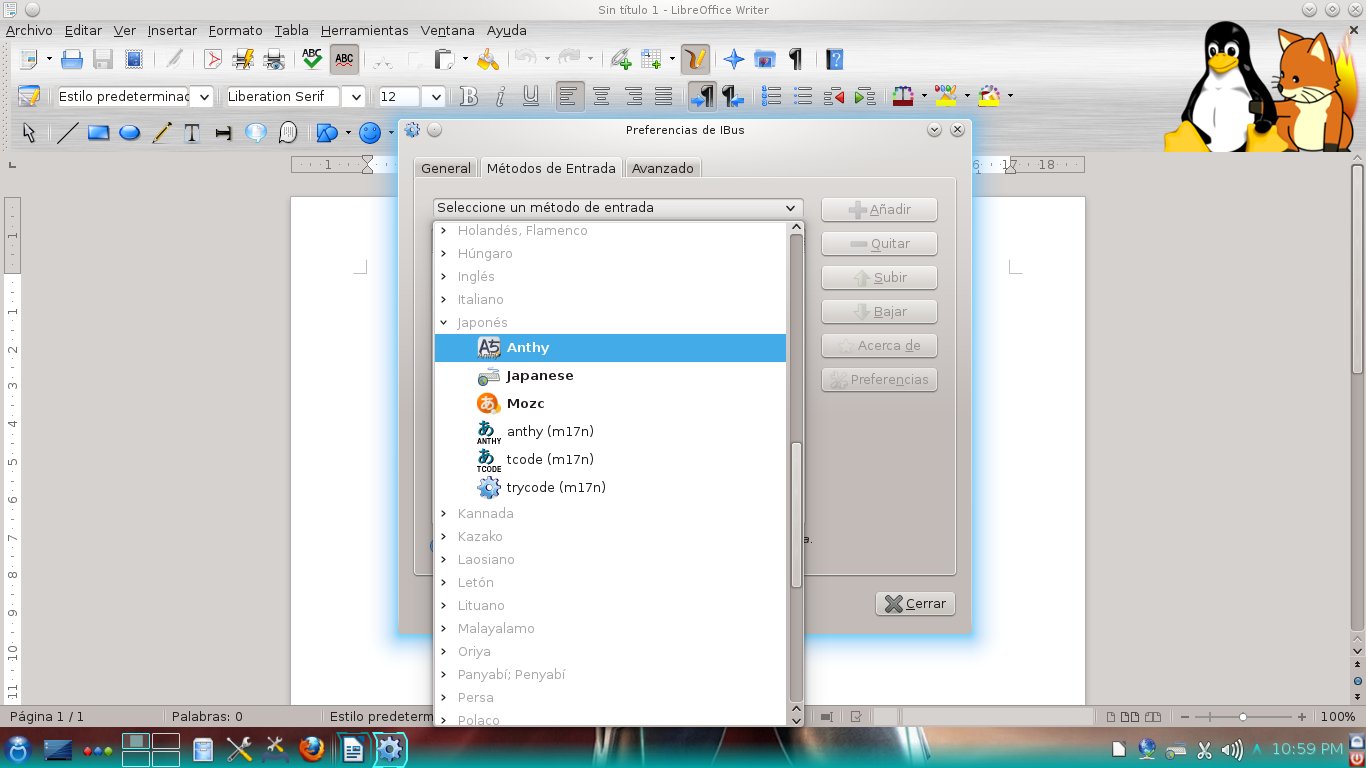
Allow me to show you my case.  After installing iBus, anthy, and all required dependencies, you log out and back in to get iBus working. This is what you get:


iBus is active, showing only "English keyboard"


You right click and go to preferences to add extra languages


You scroll down and locate Anthy by expanding "Japanese"
After adding it, Anthy should be working.  But you click on the iBus applet and...back to square 1: English keyboard only. You can repeat that as many times as you like, using all languages that you desire.


Regardless of what you do, iBus simply refuses to "remember" any additional language you choose.  Not a very usable IME, right?

In Mageia 2, iBus would work, but would mess up with the Spanish keyboard map, ruining your chance to type accents correctly.  In Mageia 3, the said IME is simply dysfunctional and the developer won't add the scim-anthy package that is missing in SCIM so that Japanese input works...because the idea is to promote iBus, an IME that is now in a worse state than it was in Mageia 2.

I must confess that, for a moment, I got really angry.  I finally grasped the spirit of the hurt users who got the infamous WONT FIX tag for the bugs they filed.

But then my anger ebbed when I tried to see the position of the developer.  iBus is, in all accounts, a great tool.  SCIM is a good oldie, but it is somewhat difficult to get working.  Developers have the right to work on what they choose, especially when they squash bugs voluntarily and without any monetary compensation.

So, instead using this as an excuse to release all the tension that has accumulated lately (these last two weeks have not been a ball, really), I decided not to show how fluent I am in sarcasm when rabid. Ken Starks said that "rants are best served cold".  He is right.

For my part, I waited until my wrath, the propeller that efficiently takes me to the Land of a Thousand-and-One Regrets, ceased to spin.  Then I filed another bug.  This time, for iBus.

I truly hope they get to fix the problem.

UPDATE (May 23, 0:23)
I recently changed my desktop install from Mageia 3 Live to Mageia 3 DVD.  It turns out that iBus works now like a charm.  I guess the bug only affects Live installs. 

domingo, 19 de mayo de 2013

Mageia 3: Here's what I gained and what I lost

Mageia 3 was released today and I downloaded the Live DVD version to replace my Mageia 2 Desktop install without further consideration.  Normally, I test the betas and the RC of a distro carefully in a virtual machine.  This time, sadly, I had no time to do that.

In my old Windows days, I would simply install the new release on top of the old one.  If something went wrong, I used the "bear-and-grin philosophy.  With Linux, I have been extra careful before updating the OS, but I guess that this was the time to test whether or not I could leap blindfolded into a new Mageia OS.  So, here is the summary of my adventure:
Mageia 3, here I go!!!

First impressions

I moved from a 32-bit architecture to the x86-64 architecture that the Live DVD includes.  To make my life easier, I wiped out the root partition and left the home partition intact.

The DVD booted without a problem and, after asking me the regular questions (language to use, if I accepted the license, where to install), the process completed in about 16 minutes.  I was prompted to add my root and user password and to reboot.  Again, I chose to use GRUB and not GRUB2 because I am not confident with the latter quite yet.

The system booted picking up my other OSs without a problem.  Then, Mageia 3 enabled the network and started downloading the common repositories.  After this process, I saw my desktop.  Although my wallpapers had been replaced by a solid black color, I simply located my favorite pictures and put them back on.  My personal settings had been preserved (effects, configurations, icons, etc), so I was quite relieved.

With KDE 4.10.2, the system became noticeably faster.  I tried to pinpoint the changes, but they were not so easy to spot for my untrained eye.  However, I gradually noticed that menu translations were more consistent, that the "home" tag had been replaced by "START" under "PLACES", that all my other partitions were listed under "DEVICES" and that the "space available" mini bar that appeared below a connected USB device was gone and only the big bar at the foot of the Dolphin window stayed.  I guess the duplicity was purged.  The notification system seemed to have received a cleaning, too.

I also noticed some new software entries in the general menu.  I decided to explore those later because I wanted to reinstall my favorite programs.  Thus, I fired up MGG (oh, new graphics that match the start screen) and enabled some other repositories (backports, tainted).

Mageia 3 played MP3s out-the-box.  Amarok impressed me with its performance this time!  However, Mageia 3 got stuck on some .mp4, .flv, and .mpeg video files.  I installed VLC (which took care of the video problems), audacious, and audacity.  So far, Mageia 3 was performing as a great substitute for my Mageia 2 install.  I saw myself as a version of Mario, the game character, jumping up and falling on top of mushrooms that could not stop me.  But then...

Watch out, Mario!  Here's the boss!

I installed Wine, the x86-64 version, that is.  Some of my programs were not working...

What do you do then?

I mean, it's not that those Windows-based programs are absolutely required.  However, they are convenient to have around.

So, I uninstalled the 64-bit version of Wine and got the 32-bit one instead.  Problem solved, let's go on!

That was too easy...

Here's the REAL boss!

I must have an IME to type in Japanese.  In Mageia 2, I gave up iBus because it messes up the Spanish tildes (accents) in LibreOffice.  That was not a big deal because I had always used SCIM anyway.

In Mageia 3, iBus refused to display the Anthy Japanese IME regardless of what I did. It also changed my keyboard configuration from Spanish to English and, on top of that, the tildes in LibreOffice were a mess, as expected.
"I'm going to be your opponent, Mario"

"OK, iBus is not an option," I thought. "Fine, let's install SCIM and forget about this problem".

And I installed SCIM only to find out that, after doing all I know to enable it, the IME simply refused to work properly.  Again, Anthy was not showing...

There I was, with a great system that did everything I needed, except accepting Japanese input.

I was a little discouraged, but open MCC and, after a while, discovered that a package was missing: scim-anthy!  Obviously, without it, I could never make SCIM work with Anthy.

I Googled "scim-anthy rpm x64" and landed on RPM pBone.net, where they were hosting a scim-anthy package built for PCLinuxOS.  I downloaded it and, in a desperate move, I installed it to Mageia 3.  MCC simply asked me to install Kasumi along.  I accepted and MCC retrieved Kasumi from the Mageia repositories to do its thing.  The computer did not blow up.

Not a confident Mario any longer, I opened LibreOffice and...Anthy was there!
よかったね!本当に、よかった!PCLOS、たすけてくれて、ありがとうな!

With SCIM working, I filed a bug and, more at ease, finished adding up the remaining software that I need to work comfortably with my new Mageia 3 Desktop install.

Overall Balance

I got a good scare with the IME, but it's working now.  Aside from that, everything seems to be performing right on cue.  KDE is responding faster, Jovie and its text-to-voice service is working in multiple languages, and I haven't seen any major problem, like a crash or something.

I guess the leap of faith was worth it.


UPDATE (May 21, 7:33PM)

I also updated my laptop from Mageia 2 to Mageia 3.  As with the desktop install, everything worked fine.  However, despite I use the fix I described here to get Mageia 2 pick up the WPA2 wifi of the university, Mageia 3  simply refused to work with it for two hours.  Then, the problem solved by itself (?!).  I hope the rainstorm had something to do with it.
 

lunes, 25 de febrero de 2013

Typying in Japanese with Firefox: SCIM in Mandriva 2011/Mageia 2

Yesterday, I shared how to get SCIM to behave correctly to handle Japanese typying in PCLinuxOS 2013.02.  Thanks to that discovery, I learned the way to enable SCIM when using Firefox in Mandriva 2011/Mageia 2.

First of all, let me say that while iBus does the same and can be installed fairly easy in both Mandriva 2011 and Mageia 2, the problem is that it ruins the keyboard accents in Spanish for those people who work in that language with LibreOffice.  Therefore, SCIM is a better option.

I am running Firefox 19.0 at the moment, but this trick works with previous versions of the browser and future ones, too (Aurora and Nightly).

To activate Japanese IME (SCIM) in Mandriva 2011 or Mageia 2, the following packages are needed:

1. Japanese fonts (Use MCC to get them)
2. Scim (and all of its dependencies)
3. Canna (and its dependencies)
4. Anthy (and its dependencies)
5. UIM (make sure that the bridging packages are included)

Once all the packages are installed,open the terminal Konsole and use SU to log in as root with your password.

Then go to /etc/sysconfig by using
cd..
cd..
cd etc
cd sysconfig

once there, activate Kwrite by typying
export $ (dbus-launch)
kwrite

The idea is to modify a file called i18n.
When Kwrite is functional, using the open icon, and locate the file i18n to open it. Once it is displayed, append the following lines to the end of the file and save it.

GTK_IM_MODULE=scim
QT_IM_MODULE=scim
XIM_PROGRAM="scim -d"
XMODIFIERS=@im=SCIM

Close the terminal and then go to usr/share/X11/xdm
Once there, open Konsole and type su and the system will ask you for your root password.  Enter it and then type
export $ (dbus-launch)
then type kwrite (to start Kwrite and edit a file)

Once Kwrite appears, open the file Xsession with it. You have to append the following lines before the line that starts with exec
SCIM working with Firefox in Mandriva 2011
 
export XMODIFIERS=@im=xim  
export GTK_IM_MODULE=scim-bridge
export QT_IM_MODULE=xim
export XIM_PROGRAM="scim -d"

Save and log out and back in to your session.  That's the end of the show.  From now on, your browser will accept Japanese input for searches, or searches in other languages (Korean, Thai, etc) as long as you have the fonts for those languages installed.

The good thing about this method is that it also enabled SCIM for LibreOffice 4 (which is not in the official repositories of Mandriva/Mageia yet).

SCIM working with LibreOffice 4 in Mageia 2

domingo, 24 de febrero de 2013

Japanese Input in PCLinuxOS 2013.02

I've been trying to get the latest release of PCLOS to accept Japanese input.  First, I made the changes that I explained here.  Basically, you have to download the required packages and add these lines to the file i18n: 
GTK_IM_MODULE=scim
QT_IM_MODULE=scim
XIM_PROGRAM="scim -d"
XMODIFIERS=@im=SCIM

I did that using the command
export $ (dbus-launch)
to edit the files with Konsole, as I had also explained here once.

I also installed Abiword (as it helped me once to test SCIM) and removed the LibreOffice KDE integration package, which has prevented me to fire up SCIM both in Mandriva and Mageia.  Then I followed the detailed directions for PCLOS here

However, after trying this process in PCLinuxOS 2013.02, all I achieved was to freeze the desktop when attempting to launch any application.


Today I found the culprit and fixed the problem. In
/usr/share/X11/xdm  you have to open the file Xsession, to which you will append the following lines before the line that starts with exec
export XMODIFIERS=@im=xim  
export GTK_IM_MODULE=scim-bridge
export QT_IM_MODULE=xim
export XIM_PROGRAM="scim -d"


The problem was that the first line must read xim at the end, not SCIM, as I had detailed before.

By the way, remember that PCLOS shows the IME on demand.  You have to press CTRL + space to work with it.  日本語がきっと書けますよ!

Oh, and the best part of this method is that Japanese IME also works with Firefox.

I wonder if this can be applied to Mageia/Mandriva to enable Japanese in Firefox...
できればいいなあ。

I'll try that tomorrow.

lunes, 24 de diciembre de 2012

A problem with iBus in Mageia 2 and Mandriva 2011

I just found an interesting problem in the way Mageia 2 handles typing Asian languages with iBus, the Input Method Editor (IME) that is configured easily during the installation of the distro.

For work reasons, I need my computers to be able to handle Japanese (and for fun, Korean and Thai).  You can do this with iBus (a more modern IME) or SCIM.  I chose iBus because you can install it during the installation process of Mageia. 

I had not seen this situation before because I have installed iBus only to computers that have an English keyboard.  However, since my main desktop computer has a Spanish keyboard, when I opened LibreOffice, I discovered that iBus was preventing the keyboard to display the accents ("tildes") of Spanish and those of French.

After using the SU command and inputting my root password, I wrote this in the terminal:
cd /etc/sysconfig

export $(dbus-launch)

kwrite

Then, when the graphical interface of kwrite came up, I opened the file i18n and found these entries related to iBus:


GTK_IM_MODULE=ibus
QT_IM_MODULE=ibus
XIM_PROGRAM="ibus-daemon -d -x"
XMODIFIERS=@im=ibus

I played with them a bit and the only thing I achieved was to break the IME, which slowed down the session start in Mageia.  Therefore, I tried to install automatically good old SCIM from the locale administrator in the Mageia Control Center.  It told me that there was no scim-tables packages, but I restarted the session anyway to find that SCIM was, effectively, not working

No problem.  I went to the file i18n in /etc/sysconfig again and saw that the following lines had been changed to make SCIM work instead of iBus:


GTK_IM_MODULE=scim
QT_IM_MODULE=xim
XIM_PROGRAM="scim -d"
XMODIFIERS=@im=SCIM

The problem was the second line.  It has to read
QT_IM_MODULE=scim

so I changed it.

The next step was to remove the libreoffice-kde4 integration package.  After doing that, SCIM started to work and I could type the correct Spanish accents.

Mandriva 2011 shows the same problem with iBus if you have a Spanish keyboard.  However, although the locale manager installs SCIM with the missing scim-tables package, it took me more time to get SCIM to work.  It so happened that Mandriva did not install several important dependencies (scim-bridge-gkt, scim-bridge-qt4) and libreoffice-gnome, which were needed for the IME to work (provided you remove the package libreoffice-kde4).

sábado, 16 de abril de 2011

Testing Japanese IME in Mageia 1 Beta1 (with Libre Office!)

UPDATE:
After filing a bug report, the Mageia team fixed the problem in Mageia 1 Beta 2 Cauldron. Now Anthy works perfectly fine with SCIM. You also get the option of using iBus for Japanese IME, which is a lot simpler. Read about it here.

So, here I am, typing this entry from Mageia 1 Beta1.
Since I haven't encountered any problems so far, I decided to live dangerously and pushed my luck: how about testing the Japanese IME with SCIM? That works flawlessly in Mandriva with Open Office, but I haven't managed to make it work in Libre Office in this OS.

Given the fact that Mageia ships with Libre Office, I thought it would be a nice experiment to see if I can follow in Mageia the same process to activate Japanese input in Mandriva and type both in kana and kanji.

For those of you who might be interested, I described the procedure to follow in Mandriva 2010 here. However, Mandriva 2010.1 created some problems (that I could circumvent and described here).

So, I downloaded all the packages that are available in the Mageia repositories (I noticed that there was no SCIM-ANTHY, so I predicted problems).

Then, after using the SU command and inputting my password, I tried to add the required lines in the i18n file by using gedit, but the program wouldn't run:

[root@localhost sysconfig]# gedit
**
GLib-GIO:ERROR:gdbusconnection.c:2279:initable_init: assertion failed: (connection->initialization_error == NULL)
Abortado
[root@localhost sysconfig]#

Thus, I tried Kwrite, which has never worked for me in Mandriva for this particular purpose and I got another bash problem:

[root@localhost sysconfig]# kwrite
kwrite(4738): Session bus not found
To circumvent this problem try the following command (with Linux and bash)
export $(dbus-launch)

KCrash: Application 'kwrite' crashing...
KCrash: Attempting to start /usr/lib/kde4/libexec/drkonqi from kdeinit
sock_file=/root/.kde4/socket-localhost/kdeinit4__0
Warning: connect() failed: : No existe el fichero o el directorio
KCrash: Attempting to start /usr/lib/kde4/libexec/drkonqi directly
drkonqi(4739): Session bus not found
To circumvent this problem try the following command (with Linux and bash)
export $(dbus-launch)

[root@localhost sysconfig]#

Discouraged, I was about to give up, but decided to read the information that the terminal was giving me... and I saw that it was giving me the solution!

To circumvent this problem try the following command (with Linux and bash)
export $(dbus-launch)

So I typed
export $(dbus-launch) kwrite

and this was what I got:

[root@localhost sysconfig]#

I typed krwite and this is what happened:

Connecting to deprecated signal QDBusConnectionInterface::serviceOwnerChanged(QString,QString,QString)
kbuildsycoca4 running...
kbuildsycoca4(4901)/kdecore (services) KServicePrivate::init: The desktop entry file "/usr/share/applications/kde4/trash.desktop" has Type= "Link" instead of "Application" or "Service"

kbuildsycoca4(4901) KBuildServiceFactory::createEntry: Invalid Service : "/usr/share/applications/kde4/trash.desktop"

After which, kwrite launched and I could append the lines to the i18n file.

Then I proceeded and removed the Libre Office kde integration package and, after restarting the session...

やった!マジェイアは にほんごをかくことができますよ!


The problem:

Anthy is not working, so I'm using Canna...which is fine, but I cannot get Canna to change kana into kanji (this feature works in Mandriva/Open Office).

Oh, well, but I achieved something, didn't I?

domingo, 30 de enero de 2011

How to install Libre Office in Mandriva 2010.2

Mandriva (the distribution) comes with Open Office and, apparently, the company behind it has not voiced its support toward Libre Office, as many other Linux companies already have (including the Mageia project) (Read here the list). Of course, the similar circumstances that triggered the existence of both Libre Office and Mageia might be a little embarrassing for Mandriva (the company) to admit right now.

That is, nevertheless, of little significance for the end user and, if that end user happens to be a Linux beginner, those internal tensions within the Linux world are pretty much incomprehensible.

Let us assume that you are a newbie running Mandriva 2010.2. (like me, I guess). You know that Linux distributions have differences; for example, while Debian uses packages named .deb, Mandriva requires packages known as .rpm.

You also know that Linux distros have a different release schedule. Therefore, you have to wait until mid 2011 to get a new version of the distribution and to find out if Libre Office will replace Open Office. But you want Libre Office to run in your Mandriva 2010.2 system right now, so you go to the download section of Libre Office and are greeted by many different links. As you know how to read (something you learned as a child and have been practicing ever since), the many links do not scare you away: you discover that you need to locate first your language and the appropriate packaging (for Mandriva, you definitely need RPM.

So, you download the file... now what?

Installation of Libre Office in Mandriva 2010.2

You need: The installation file, your root password, and self confidence.

Once you have the file, you right-click on it and select "extract here, auto detect subfolder". Then you get inside the newly created folder and go inside a sub folder called RPMS.

WARNING:
the following step is not for the faint of heart as it requires use of the TERMINAL!!

Yes, the above is sarcasm. I've read too much about how complicated and inconvenient it is to use the terminal...well, not in this case. I could do it and, believe me, I have no training in programming.

Once inside the folder RPMS, go to the window menu and click on "tools". Select "open terminal" to deal with the friendly black screen.
1. Type su
The terminal returns: password:
2. Type your root password (you have it, don't you?)
The terminal returns: [root@localhost RPMS]#
3. Type urpmi *.rpm and relax while the computer does its own thing. Once it's over, you will see the same prompt ([root@localhost RPMS]#)
4. Now, close the terminal (Boy, that didn't hurt, did it?)

Double click to open the folder called desktop-integration.
Once inside this folder, go to the window menu and click on "tools". Select "open terminal" to deal with the charming black screen. YES, AGAIN! But you are not afraid, are you?
1. Type su
The terminal returns: password:
2. Type your root password
The terminal returns: [root@localhost RPMS]#
3. Type urpmi *.rpm and see what the computer does this time. It might give you a warning about some dependency-requirements not met. Before you freak out, READ. It's about SUSE and Red Hat. You are using Mandriva, so just say yes to continue and relax while the computer does its own thing. When it's over, you will see the same prompt ([root@localhost RPMS]#)
4. Now, close the terminal (Boy, that was enlightening, wasn't it?)

After this, your OFFICE menu in Mandriva will display icons for Libre Office.
No, having both Libre Office and Open Office does not imply that the two office suites fight like cats and dogs within your computer, in case you are wondering.

My only complaint about Libre Office so far is that I haven't been able to use SCIM (the input method editor) to enter text in Japanese. That's a big concern for me. I hope to find a solution soon. In the meantime, I'll keep Open Office for that purpose... or Abiword.

My First 12 Days with Mageia 10: How to enable repos with dnf5

Well, 12 days have passed since I migrated all of my desktop, laptop, and portable work system to Mageia 10. I have not used the work system...