Passwords are, without a doubt, a convenient derivation from the security device from ancient times: token showing. Yes, in very old civilizations, to recognize a member of a particular clan, a token had to be shown.
Tokens, however, were not safe; one can lose the object and, therefore, be taken as an intruder and a potential menace (with all the undesirable consequences for the person).
Thus, it was only logical to substitute the material object by a coded word that, as everyone knows, has the particularity that it is sometimes difficult to remember...especially if you have many passwords to remember and financial institutions ask you to change them at least once a month.
In my multi-boot ZaReason Strata, I have seven different Linux distros. Somehow I managed to remember the different user and root passwords for each one of them until I updated OpenMandriva Lx 2014.1 to 2014.2 (the Scion). Maybe because of stress, or aging, or whatever reason, the password for OpenMandriva Lx 2014.2 would not stick to my memory. I had to reinstall the Scion twice because I forgot the user password and ended up locked out from my account.
Well, I just finished reinstalling it AGAIN. Yes, that makes it three times. The funny thing is that, the former two times, I was sure to have chosen a password that I could remember easily. It seems that it was easier to forget it.
Then I read this comic strip.

I tested this human-friendly method and it really works! Simple and effective.
One can but imagine the future problems if they actually substitute passwords with facial gestures, secret taps on touch surfaces, or biometrics. Scary.
A blog to compile what I have learned (and what I am learning) about Mandriva (and GNU/Linux in general) since 2009, when I migrated. Current distros I'm using: OpenMandriva Lx ROME 5.0, Mageia 9, MX 19, Manjaro 23.1, and Elive 3.
sábado, 10 de octubre de 2015
jueves, 1 de octubre de 2015
On the on and off relationship between FirefoxOS and WhatsApp
![]() |
| Good-bye, ConnectA2! |
ConnectA2 was not a perfect app. Sometimes it would fail to connect and, after an update, it would constantly receive messages from +server saying "Unable to parse the resource". This messages were annoying, specially because one could several during a day. I once got 11 in two hours!
It also lacked certain characteristics from the real WhatsApp which, however, was never a problem for me. I mean, I was conscious ConnectA2 was NOT WhatsApp. So, expecting absolute equivalence was foolish. After all, I was using a FirefoxOS phone, not an android phone.
![]() |
| LoquiIM...very similar to KDE's Kopete |
Once that ConnectA2 got seriously broken, I had to remove it and started using LoquiIM. This app lets one configure accounts on Facebook, Google Hangouts and, of course, WhatsApp. I only used it to access the WhatsApp network and found it quite efficient. However, every time WhatsApp released an app update, LoquiIM would fail. Of course, I was then using a developer phone. When I got the commercial FirefoxOS phone, LoquiIM was the only app that could access the WhatsApp network.
![]() |
| OpenWapp, show me what you can do |
OpenWapp's design is very consistent with the rest of the apps on the FirefoxOS platform (HTML5?), so it feels very natural on the phone. However, I have noticed that it takes some time to display incoming messages.
For the time being, I will keep using OpenWapp. Let us see how it goes. If it performs poorly, I can always go back to LoquiIM or, if they fulfill their promise, I can give ConnectedIM a try.
sábado, 19 de septiembre de 2015
Happy Software Freedom Day!
Because software freedom becomes significant when Microsoft wants to force Windows 10 into your computer regardless of your preference...
viernes, 18 de septiembre de 2015
The Changes in the Geography of Linux World
Maybe you remember how the explorer Dedoimedo, back on May 13, 2011, produced the first map showing the world of Linux.
Since then, many events have taken place in the universe of technology: Steve Jobs passed away and Tim Cook started directing Apple, Steve Ballmer, who called Linux a cancer, stepped down from his position as CEO and Satya Nadella took the reins at Microsoft, claiming that "Microsoft loves Linux".
One can also remember Valve's release of a native Linux Steam client, the systemd storm, the bankruptcy of Mandriva S.A., the tension between the Ubuntu community and Canonical, to mention some of the most notorious changes in the world of Linux in these four years that have elapsed since the map was created.
Those events have impacted the geography of Linux, so I decided to adapt the map to show the changes.
1. Xandros disappeared.
2. Mepis has vanished; MX was created later.
3. Mageia 1 was released.
4. Pardus became Debianized, ditching the Pisi package manager in the process. Pisi Linux is born as a response.
5. The OpenMandriva Association released OpenMandriva Lx.
6. Microsoft admits it is using Linux.
Wow! All these in four years!
Since then, many events have taken place in the universe of technology: Steve Jobs passed away and Tim Cook started directing Apple, Steve Ballmer, who called Linux a cancer, stepped down from his position as CEO and Satya Nadella took the reins at Microsoft, claiming that "Microsoft loves Linux".
One can also remember Valve's release of a native Linux Steam client, the systemd storm, the bankruptcy of Mandriva S.A., the tension between the Ubuntu community and Canonical, to mention some of the most notorious changes in the world of Linux in these four years that have elapsed since the map was created.
Those events have impacted the geography of Linux, so I decided to adapt the map to show the changes.
| The geography of Linux in 2015. Adapted from Dedoimedo's work. |
2. Mepis has vanished; MX was created later.
3. Mageia 1 was released.
4. Pardus became Debianized, ditching the Pisi package manager in the process. Pisi Linux is born as a response.
5. The OpenMandriva Association released OpenMandriva Lx.
6. Microsoft admits it is using Linux.
Wow! All these in four years!
jueves, 13 de agosto de 2015
My ZTE Open Phone Finally Came Back!
Sometime ago, I managed to upgrade my Firefox OS on the ZTE Open to version 1.2. However, this upgrade broke many things, like the GPS and other features.
No matter how much I tried to downgrade, the phone would never respond.
That changed today, though.
I tried a crazy approach and deleted a folder in the root folder. Then, I put the 1.10B06 zip there and rebooted the phone.
While the phone was rebooting, I pressed the power and the volume up buttons together to enter recovery mode. Once there, I selected the zip file without much hope because I had tried that a zillion times with no success.
But the phone acted differently and showed me a bar with the words "updating."
In less than 2 minutes, it showed "finished" and I rebooted the phone to a fully operational 1.1 downgrade.
The ConnectA2 app to use WhatsApp also works now.
Who would have said that a desperate move would save the phone? But you know the saying: Genius is 1% inspiration and 99% desperation! :P
No matter how much I tried to downgrade, the phone would never respond.
That changed today, though.
I tried a crazy approach and deleted a folder in the root folder. Then, I put the 1.10B06 zip there and rebooted the phone.
While the phone was rebooting, I pressed the power and the volume up buttons together to enter recovery mode. Once there, I selected the zip file without much hope because I had tried that a zillion times with no success.
But the phone acted differently and showed me a bar with the words "updating."
In less than 2 minutes, it showed "finished" and I rebooted the phone to a fully operational 1.1 downgrade.
The ConnectA2 app to use WhatsApp also works now.
Who would have said that a desperate move would save the phone? But you know the saying: Genius is 1% inspiration and 99% desperation! :P
On August and Broken Electronics
Some days ago, Nixie Pixel shared this image on Google+. Unfortunately for her, August started with her cellphone, laptop, and desktop computer breaking.
One follower replied to her that he has seen that something always breaks in August and, therefore, he has learned to save money ahead of time, destined to the fixing expenses.
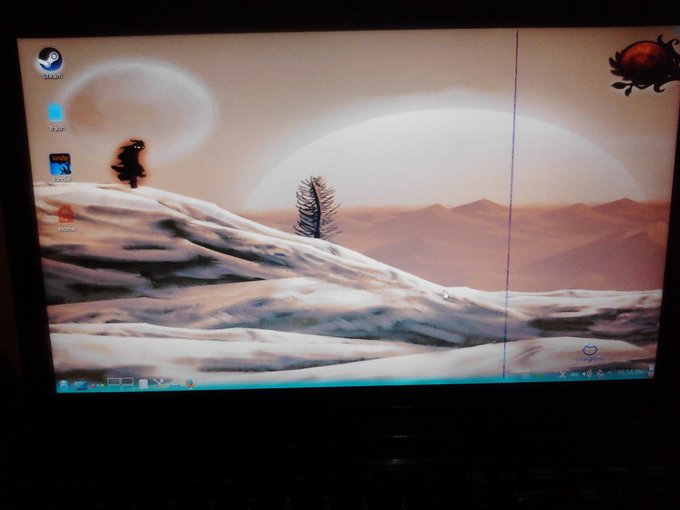
I was amused by the post until yesterday... The screen of my ZaReason Strata displayed a blue vertical stripe that eventually extended from the top to the bottom into a full line.
This happened because I was moving the laptop while carrying some books and I almost dropped it. Not to let it slide to the floor, I exerted additional pressure on the lid against my leg and, surely, I damaged the screen.
The good thing is that there is a place nearby where I can take my laptop to have the screen replaced. I trust the technician, too.
It turns out that I am the first client that brings him a Linux laptop.
He fixed the Strata fast and, as I tested the KDE effects on PCLinuxOS, he was impressed by the beauty of Linux. He also praised the solid construction of the Strata. He said that other clients have cracked the screen of their laptops with less than what I did to mine.
That confirms my decision. I will keep buying from ZaReason. :)
One follower replied to her that he has seen that something always breaks in August and, therefore, he has learned to save money ahead of time, destined to the fixing expenses.
I was amused by the post until yesterday... The screen of my ZaReason Strata displayed a blue vertical stripe that eventually extended from the top to the bottom into a full line.
![]() |
| Blue line... |
This happened because I was moving the laptop while carrying some books and I almost dropped it. Not to let it slide to the floor, I exerted additional pressure on the lid against my leg and, surely, I damaged the screen.
The good thing is that there is a place nearby where I can take my laptop to have the screen replaced. I trust the technician, too.
It turns out that I am the first client that brings him a Linux laptop.
He fixed the Strata fast and, as I tested the KDE effects on PCLinuxOS, he was impressed by the beauty of Linux. He also praised the solid construction of the Strata. He said that other clients have cracked the screen of their laptops with less than what I did to mine.
That confirms my decision. I will keep buying from ZaReason. :)
domingo, 19 de julio de 2015
Pisi Linux 1.2 is available!
This confirms Megatotoro's finding: Pisi Linux is alive!
At last in DistroWatch!
![]() |
| The kitty shows the famous smile of Korean actor-singer Bi (Rain) |
And so I Won...!
I woke up early today with all the intention of tackling my morning jog, but I lacked the energy.
What to do?
I could go back to sleep or... play LIMBO.
Somehow, I knew I was very close to finishing it. I mean, with all those gravitational spins, how much crazier could that creepy game become?
As an additional motivation, I reminded myself that I had not won any game on Linux.
So I opened Steam and played.
It took me less than one hour to finish LIMBO.
Just like T.S. Eliot's Magi would have said, the ending was... satisfactory! ;-)
Interestingly, I experienced certain emotion (joy, a sense of achievement/completion?) from winning this game, something that resembles what one feels after finishing a jog.
I sort of understand gamers better now.
What to do?
I could go back to sleep or... play LIMBO.
Somehow, I knew I was very close to finishing it. I mean, with all those gravitational spins, how much crazier could that creepy game become?
As an additional motivation, I reminded myself that I had not won any game on Linux.
So I opened Steam and played.
It took me less than one hour to finish LIMBO.
![]() |
| LIMBO: The end sequence |
Just like T.S. Eliot's Magi would have said, the ending was... satisfactory! ;-)
Interestingly, I experienced certain emotion (joy, a sense of achievement/completion?) from winning this game, something that resembles what one feels after finishing a jog.
I sort of understand gamers better now.
martes, 14 de julio de 2015
Seen on Yahoo: Mageia a Great Desktop Distro
I saw this tonight. It's an article that talks about good Linux desktops.
Two things caught my eye:
1. The sheer admission that desktop Linux is on the rise. This is something I have suspected for quite a long time, but sites like StatCounter and Netmarketshare have been denying it with their questionable numbers and that biased tech-journalists keep hiding/misinforming.
2. When I read the article, I was surprised not to see the usual distros there: Ubuntu, Mint...
And then there's mentioning of Mageia!
Two things caught my eye:
1. The sheer admission that desktop Linux is on the rise. This is something I have suspected for quite a long time, but sites like StatCounter and Netmarketshare have been denying it with their questionable numbers and that biased tech-journalists keep hiding/misinforming.
2. When I read the article, I was surprised not to see the usual distros there: Ubuntu, Mint...
And then there's mentioning of Mageia!
martes, 7 de julio de 2015
Fun on Google: Ultraman minigame
miércoles, 1 de julio de 2015
Mageia 5: I See no Change... and That's Good!
It's been like a week after Mageia 5 was released. I installed the full DVD version to two desktops and two laptops to see what it offered.
Normally, I test a new distro more cautiously; first, I run a VM, then, I run a live version on the actual system where I wish to install before I decide to wipe out the root partition and say hi to the new OS.
But somehow I felt lazy this time. No, it was not laziness. As Megatotoro said, I was feeling bored because all my Linux systems have been working flawlessly for such a long time that I have been tinkering with my Firefox OS phones instead.
I wanted to upgrade and I sort of wanted something to break...So I tried multiple installation scenarios to maximize the chances of things going bad:
1. My old desktop. Upgrade from M4 to M5 via upgrading applet. Not only did it work, but it also corrected a minor problem I had with iBus for Japanese input!
2. My wife's laptop. DVD install. During the process, the touchpad froze. I plugged in a usb mouse and went on expecting trouble once the system had been installed. Nope, the touchpad worked and Grub 2 also played nice with Ubuntu...
3. My ZaReason laptop. Again, applet upgrade, with the additional complication of having a multiboot configuration (OpenMandriva Lx, Mageia 4, PCLinuxOS, Pisi Linux, PicarOS, Elive beta, and Mageia 5 RC). Nothing bad happened. The applet even distinguished the two Mageia systems and asked me which one I wanted to upgrade!
4. My daughter's desktop. This is a dual-boot, multisession machine. DVD install. Nothing happened here during the upgrade.
After a week, and without considering aesthetic improvements, I have seen nothing different... it feels just like the system those machines had before. Of course, that's not to belittle the great work of Mageia developers, but to say that when a user experiences no disruption after an upgrade, that is very good news.
Mageia 5 is looking solid and consistent with the user experience that was established with Mageia 1. In this world, where developers keep changing things and expect users to adapt, I, for one, appreciate the consistency.
Normally, I test a new distro more cautiously; first, I run a VM, then, I run a live version on the actual system where I wish to install before I decide to wipe out the root partition and say hi to the new OS.
But somehow I felt lazy this time. No, it was not laziness. As Megatotoro said, I was feeling bored because all my Linux systems have been working flawlessly for such a long time that I have been tinkering with my Firefox OS phones instead.
I wanted to upgrade and I sort of wanted something to break...So I tried multiple installation scenarios to maximize the chances of things going bad:
1. My old desktop. Upgrade from M4 to M5 via upgrading applet. Not only did it work, but it also corrected a minor problem I had with iBus for Japanese input!
2. My wife's laptop. DVD install. During the process, the touchpad froze. I plugged in a usb mouse and went on expecting trouble once the system had been installed. Nope, the touchpad worked and Grub 2 also played nice with Ubuntu...
3. My ZaReason laptop. Again, applet upgrade, with the additional complication of having a multiboot configuration (OpenMandriva Lx, Mageia 4, PCLinuxOS, Pisi Linux, PicarOS, Elive beta, and Mageia 5 RC). Nothing bad happened. The applet even distinguished the two Mageia systems and asked me which one I wanted to upgrade!
4. My daughter's desktop. This is a dual-boot, multisession machine. DVD install. Nothing happened here during the upgrade.
After a week, and without considering aesthetic improvements, I have seen nothing different... it feels just like the system those machines had before. Of course, that's not to belittle the great work of Mageia developers, but to say that when a user experiences no disruption after an upgrade, that is very good news.
Mageia 5 is looking solid and consistent with the user experience that was established with Mageia 1. In this world, where developers keep changing things and expect users to adapt, I, for one, appreciate the consistency.
Suscribirse a:
Entradas (Atom)
My First 12 Days with Mageia 10: How to enable repos with dnf5
Well, 12 days have passed since I migrated all of my desktop, laptop, and portable work system to Mageia 10. I have not used the work system...
-
A few days ago, thanks to one student, I realized that something funny was happening with my Linux netbook. He said that it was weird that I...
-
That's right. My desktop, which runs Windows, is infected and I blame Linux. As it normally happens in these cases, this new infection ...