jueves, 20 de septiembre de 2012

The underdog is on the loose! A glimpse of Mandriva 2012 Alpha1

Breaking news!  Mandriva is not dead.  Or maybe it was and came back to life,  not as a zombie (Bernie Lomax) this time, but as a modest, yet persistent dog that simply refuses to give up the race.

Yes, the Alpha 1 of Mandriva 2012 has recently been released.  Its code name: Tenacious Underdog!

I dowloaded the i586 .iso to give it a try on a Virtual Machine and see if it works better than Bernie Lomax, its predecessor, did.  By the way, the TP ran like a charm in my humble opinion.  Can the underdog outperform Bernie?
This is what I saw:

Installation process:
Say hi to the crazy penguin
The process is as simple as it gets.  As usual.  By the way, I do not agree with the idea that the presence of this penguin weakens the perception one can have of the distribution.  After all, computers should not be so serious.  Gimme games, Easter eggs, funny names, and the crazy penguin.  Let's bring back the joy of using a computer, shall we?


I like the penguin family!  It looks like mine...

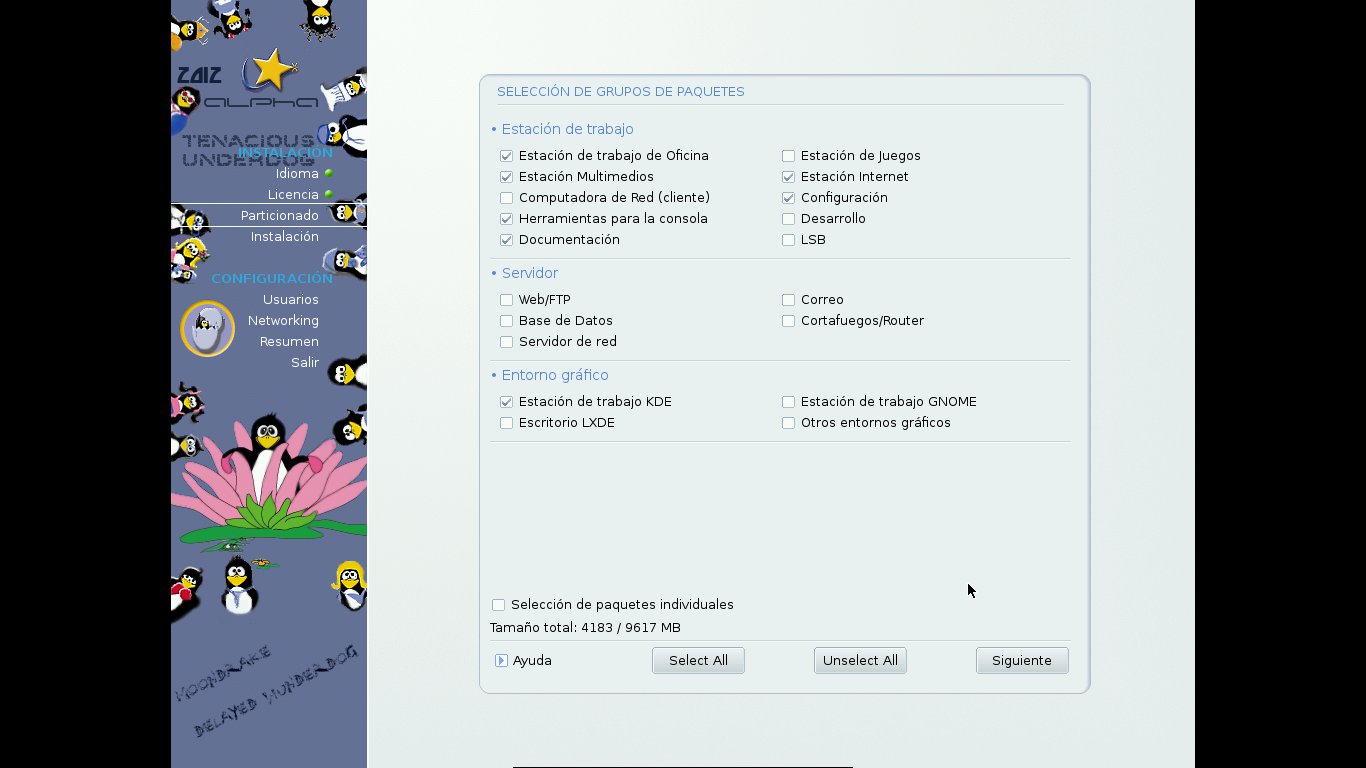
This is a nice feature. Here, it is possible to install many different packages right from the start.  Some might think that this scares newbies away.  Well, this non-technical Linux user simply drools over the options and checks all that seems interesting.


This is familiar territory

After completing some intuitive questions, the distro takes some time to install...
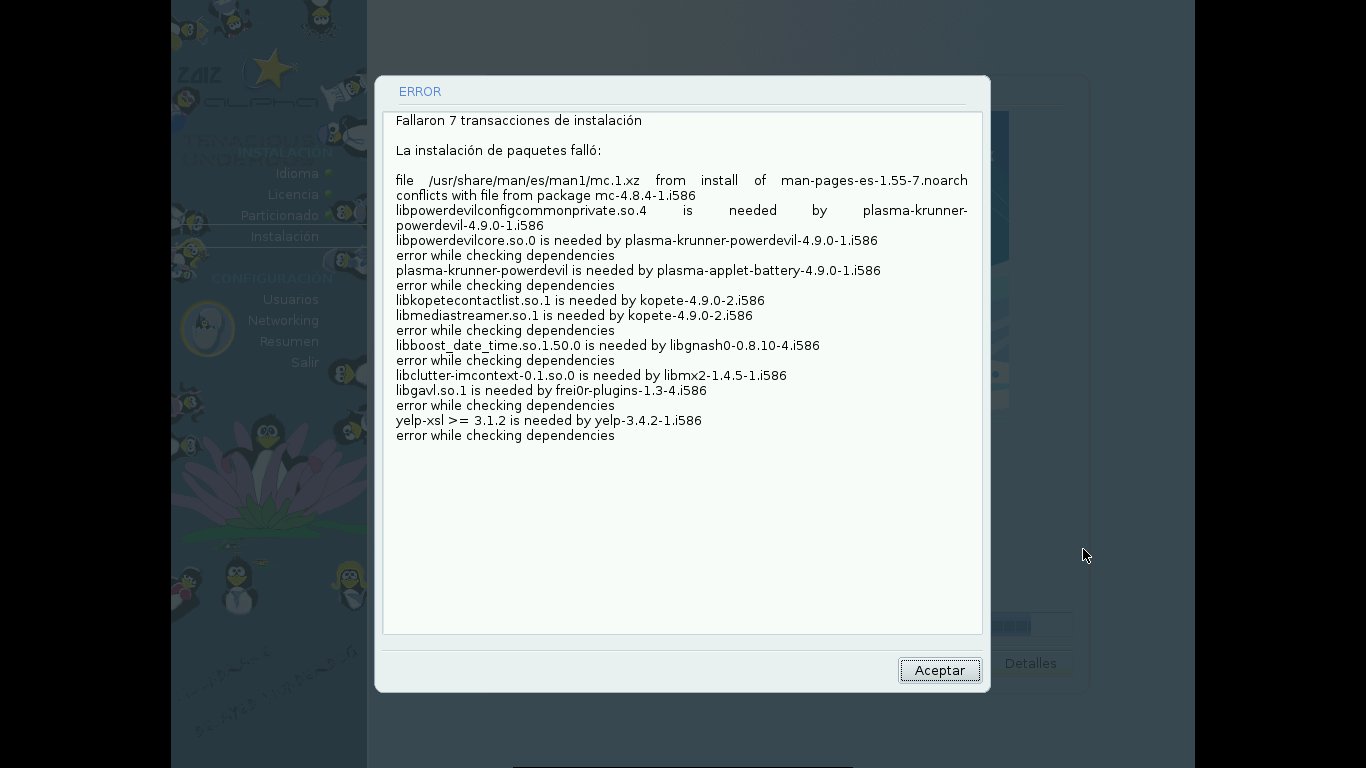


Oops!  The Spanish installation failed...
Now, this was unexpected: the installation did not finish successfully.  Before blaming anyone, I just reminded myself that this is an alpha, so some features might not be included.  I started the installation again, but in English.
*UPDATE: Per Øyvind Karlsen has fixed this issue already! 


The English install worked perfectly
The process completed the GRUB stage and then I could set up the monitor and select an IME.

This time, everything went as expected.


Desktop:

After the install, you see the same elegant log in screen that Mandriva 2011 brought.  Paradoxically, my account avatar is a cat.
You guessed it; I'm not a dog person...
You get the ROSA SimpleWelcome, launcher, stack folders and timeframe.  As I have said, I now like them a lot better than before.
This is the default desktop
I quickly downloaded a Mandriva wallpaper from the KDE pool and modified it with the GIMP.  The dog that is climbing the fence to abandon the land of oblivion seems right for the composition
 The desktop wearing something more appropriate


Final observations:

This release includes KDE 4.9.0.  It's good to see Mandriva sporting new technologies.  Best of all, this desktop environment seems well implemented, which is far more important than just having it.

In the office section, I miss the rest of the LibreOffice suite (only Writer and Calc are present).  Not a big deal; you can download the rest from the repos.

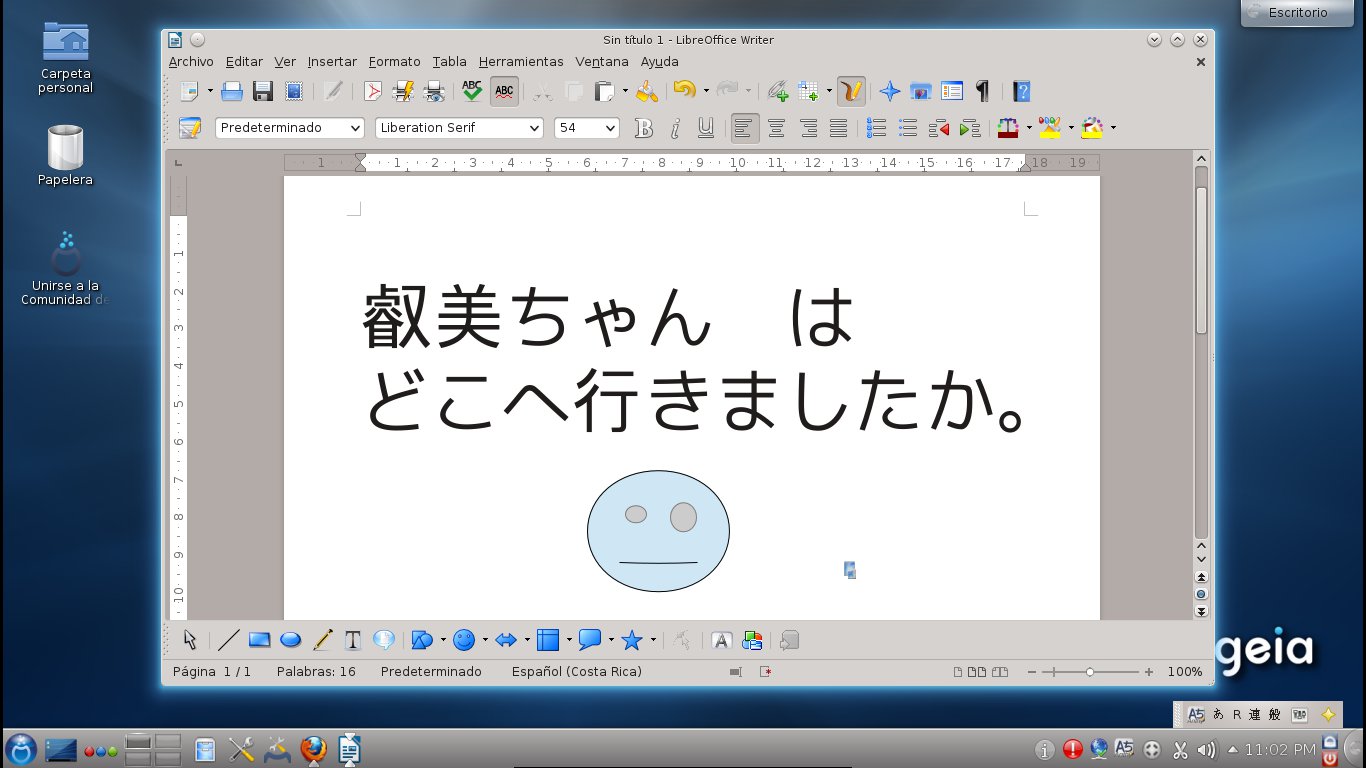
Ah, but my personal test is the factor that determines if I will continue being a Mandriva user or not.  Can it handle Japanese input?
The answer is YES!
iBus + Anthy work flawlessly.
Mandriva, I'm sticking with you.
To Per Øyvind Karlsen and all Mandriva developers, thank you for your hard work.  I'm truly looking forward to seeing the final 2012 release. Judging from the quality of TP and Alpha 1, I'm sure that Mandriva 2012 will conquer my PC, putting an end to the long reign of Mandriva 2010.2.

lunes, 10 de septiembre de 2012

Mageia 3 alpha 1 is now available

Yes, I know this version is for tests and not for reviews.
Well, that's OK because I just want to see if Mageia 3, at this early state, shows some changes and to test how it works.

Very briefly, the installation process is pretty much the same that you get for Mageia install versions (very similar to Mandriva PowerPack).  Therefore, one must install the distro to be able to see it in action because this image is not a live medium.

Once completed, I expected to see GRUB 2, but it seems Mageia 3 still boots with the GRUB I am accustomed to using.

I used the Mageia control center to add new media and retrieve software form the repositories.  Basically, I wanted to download Anthy and Japanese fonts to test if iBus works.  iBus was included during the installation process.

Mageia Control Center adding repos

I am very happy to say that iBus works perfectly with LibreOffice and Anthy, so I can type in Japanese without any problems:

Unlike my test of Mageia 2 betas, there were no database errors this time.


Although the desktop effects were not activated (this is not a big surprise because I tested the distro on a virtual machine), I noticed that alerts or error messages are now highlighted and they are displayed on the top side of the window.  The reason: Mageia 3 includes KDE 4.9.0!


I think Mageia 3 looks promising. 

domingo, 9 de septiembre de 2012

Our first UEFI challenge

Yesterday, Megatotoro and I helped a colleague who wanted to dual boot her recently bought desktop PC.  She wanted us to install Mageia 2  and we were confident because it is a process that we have done several times already.

However, when we hit the key to get into the BIOS... Surprise!  We were greeted by UEFI instead.

We thought the dual-boot enterprise was doomed.  We are not computer techies, to begin.  In addition, we had read all the problems that UEFI will give to people who want to try Linux, which was pretty discouraging.  Nevertheless, Megatotoro persisted and found the option to disable the secure boot.  Once this was done, the installation of Mageia 2 was easy.

I hope OEMs keep the option to disable secure boot.  

miércoles, 5 de septiembre de 2012

On the PCLOS 2012.08 KDE release

Katherine Noyes wrote her opinion about the new release of PCLinuxOS here.  When I read it, I did not pay a lot of attention mainly because of one reason: I had installed PCLinuxOS 2011.6 in both my desktop and experimental laptop and I was very satisfied with its performance.  Therefore, I thought, is it really necessary to bother downloading the PCLOS 2012.08 .iso, burning it to a DVD, and installing it if my computers are doing OK? After all, as a PCLOS newbie, I did not want to break a system that was working as expected.

However, I gave in and started the upgrade.

Scary tsunami wallpaper on my PCLOS 2012.08 desktop 
Now, I must say that this is by far the most pleasant upgrade I've ever performed since I migrated to Linux: I simply replaced the root partition and left the home partition intact.  I've done that before with Mandriva and Mageia, but since the results I obtained were not always optimal, I prefer to do a clean install with those systems.

PCLinuxOS was different, though.  The process lasted less than 10 minutes.  The beautified log in avatars greeted me when I rebooted the computers and the new PCLOS did not mess up with my user settings; everything stayed there.  This upgrade included LibreOffice, too, so the OS was ready to go.

The best part was that the new kernel picked up certain functions that were not recognized by the previous release.  Kudos to the PCLOS developers!

lunes, 13 de agosto de 2012

On life, death, and Linux

After a rather long period without visiting the Mandriva community chat (because of an excess of work that is taking a toll on me), I learned that Eugeni Dodonov, a former Mandriva engineer, lost his life in a bike accident a month ago.

Speak about bad news! 

Condolences to his family.

The community felt the loss powerfully and the reaction can be read in many blogs.

One initiative is to name the release of Mandriva 2012 after him as a homage.


------------------------------------------------------------------------
Of course, one never expects to read something like this.

This is one of the reasons why I use Linux, I guess.  The communities certainly make the systems that power my computer more "human", if you understand what I mean... I know because it is amazing when you grieve for a person that you actually never met or barely had contact with.


RIP Eugeni Dodonov.

lunes, 23 de julio de 2012

The Quest of Getting Midi and Karaoke to Work in Mandriva 2010.2 and Mageia 2

There are times in which a seemingly simple task becomes a challenge.  For me, this happened when I was called to substitute a Japanese teacher and wanted to use a .kar file in the class to practice.

To solve this problem, I resorted to several programs: Pykaraoke, Timidity, VLC, Audacious, and Kmid2.  Here is the story.

Chapter 1.  The adventure of enabling midis/.kar files in a Mandriva 2010.2 PowerPack Desktop PC and a Mandriva ONE 2010.2 netbook


When I realized that I was not ready to play .kar files (nor any midi), I checked Megatotoro's entry here on how he had done it in Mepis.  The process seemed pretty straighforward, so I started by downloading Pykaraoke.  However, it would not run.  Pykaraoke was not my winning card. 

Then I remembered that Timidity was not installed, so I grabbed it from the Mandriva repos.  To my despair, although the installation was successful, Timidity simply refused to launch.

In my search for answers, I saw several plugins for midi in VLC and Audacious.  I gave those programs a try, too.  Concerning the latter, I installed first:
fluidsynth, fluid-soundfont-gm, audacious-fluidsynth, and whatever dependency that the system required.

Audacious playing a midi
With everything in place, I  ran Audacious and hit CTRL+P for the preferences dialog.  I navigated to "PLUGINS" and selected the tab "input".   There, I selected AMIDI-PLUG and clicked on the "preferences" button at the bottom.  Then I selected "Fluidsynth backend" for the AMIDI plugin and clicked on the Fluidsynth button next.  there, I used the add button to go to /usr/share/soundfonts and select the 2FluidR3_GM.sf2 file.  With that, Audacious started to play the midi sound, but no lyrics could be displayed yet.


The next candidate was VLC, which stubbornly gave me a warning that MIDI playback was not supported and that "there was no way to fix the problem", a pretty discouraging message that I chose to ignore because I had seen a plugin to that purpose in the PLF repositories (vlc-plugin-fluidsynth). So, I installed it, ran VLC and clicked on the Tools menu and went to "Preferences".  That gave me a window.  To the left, I saw the "INPUT AND CODECS" button.  However, before I clicked on it, I went down and selected "ALL" for the adjustments.   That converted the panel to the left in a tree-like structure with more options.  I selected "INPUT/CODECS", audio codecs, Fluidsynth and wrote the following path in the panel:   /usr/share/soundfonts/FluidR3_GM.sf2.  That enabled midi playback with VLS alright, but still no lyrcs were displayed.

Then I installed Kmid2 and all its dependencies.  When I ran it, I went to the Preferences menu and then "Configure Kmid".  When I clicked the button "synthetizers" and then went to the Timidity tab, I finally discovered what the problem with Timidity was: Kmid2 reported a missing timidity.cfg file in /etc/timidity/

My Mandriva PowerPack 2012.2 PC running Kmid
The reason why the file was not there eluded me, but I installed Timidity on the netbook from the repos and the program launched perfectly: the .kar file started to play and displayed the lyrics.  That took care of my work situation, but I wanted the Desktop PC to do the same.  So, in the netbook, I went to /etc/timidity/, snatched the timidity.cfg file, and dropped it to the same directory in the desktop PC.  That got Timidity running at last and Kmid2 could also play and display the lyrics in the desktop PC. 
 
Chapter 2.  Getting the Elusive Kmid to Cooperate in a Mageia 2 laptop

With all this learning, I turned on my Mageia 2 laptop and tried to install Kmid2.  At first, I did not find it in the repositories, so I enabled all the repositories I could and tried again.  The Mageia control center displayed it, so I selected it with all the dependencies (fluidsynth and its own).  After the installation, I started Kmid2 but it failed to lauch, reporting that the machine could not play midis or that snd_seq was missing in the modules (something about permission denied).  As the latter problem sounded unsurmountable to a non-technical user like me, I decided to rule out the former first.  Thus, I repeated the steps to enable midi playback in VLC and Audacious and, to my relief, both programs played the sound of the.kar file.

Without a lot of confidence in my ability to fix the missing module problem, I searched the Web and found that this had been reported as bug 5892 in Mageia.  According to the report, a user had solved the problem by going to /etc/module and simply adding the line
snd_seq

Although I followed the path, I saw no file called module, so I got the most similar one (/etc/modules.load.d) and edited the file modules.conf with Kwrite, adding the line to it.  That got Kmid2 to work in Mageia 2 as well.

I hope this experience helps those with some karaoke woes in Mageia and Mandriva.

jueves, 12 de julio de 2012

Adios, PardusLife!

Hoy encontré esto en mi correo...malas noticias sobre PadusLife.

http://parduslife.com/2012/07/12/me-retiro-es-el-fin-de-pardus-life-no-lo-se-dejo-la-puerta-abierta/

Es muy triste que Pardus, una de las mejores distros basadas en KDE, desaparezca.  Esperemos que Pardus Anka reviva el proyecto...

miércoles, 13 de junio de 2012

La historia de la falla del disco duro de Eimi

Eimi se levantó y se robó una de mis revistas...(cortesía de Megatotoro)
A mi hija Eimi le encantan las computadoras ("pah-teh", como ella les dice). Una de sus actividades favoritas es encender su PC de escritorio y llevarme hasta ella para que la ponga a ver videos musicales.  Esta computadora corre Mandriva Desktop 2011 y, gracias a la conveniente Línea de Tiempo de ROSA, Eimi, que brinca en la silla de alegría, sencillamente apunta al icono agrandado del video que quiere ver.  A veces, ella incluso pronuncia una palabra para identificar el video.  Por ejemplo, la canción "Simplemente irresistible", de Robert Palmer es "mamá", la de Totoro es "toto" y, para mi desesperación, Eimi nunca falla en identificar el clip de Mr. Bean bailando "Mr. Bombastic" como "papá". 
"Mamá" versus "Papá"  ¡Ah no, Eimi!

Estabámos mirando algunos videos de YouTube cuando la computadora repentinamente se reinició y el sistema operativo no quiso arrancar.  Resulta ser que hubo un cambio de corriente y algunos de los sectores del disco duro se tostaron.  Sí, fue mi culpa por no haber sustituido la vieja UPS.

Por suerte, pude reinstalar el sistema en otra partición en menos de 20 minutos...era la partición de Windows, pero Eimi no va a echar de menos ese sistema operativo, estoy seguro. :-)


The story of Eimi's HD failure

Eimi got up and snatched one of my magazines... (courtesy of Megatotoro)
My daughter Eimi loves computers ("pah-teh", as she calls them). One of her favorite activities is to turn on her desktop PC and take me to it to play music videos.  This PC runs Mandriva Desktop 2011 and, thanks to the convenient ROSA Time Frame, Eimi, bouncing on the chair with joy, simply points to the enlarged icon of the video that she wants to see.  Sometimes, she utters a word to identify the video.  For example, Robert Palmer's "Simply Irresistible" is "mamá", Totoro's song is "toto" and, to my distress, Eimi never fails to identify the clip of Mr. Bean dancing "Mr. Bombastic" as "papá". 
"Mamá" vs "Papá"  C'mon, Eimi!

We were watching some YouTube clips when the computer rebooted and the OS refused to launch.  It turns out that there was a power surge and some sectors of the HD fried.  Yes, it was my fault because I forgot to replace the old PSU unit.

Luckily, I could reinstall the system to a different partition in less than 20 minutes...that was the Windows partition, but Eimi will not miss that OS, I'm sure :-)


Mandriva finally died! Well, sort of...

Many Linux users have already proclaimed Mandriva deceased and buried it. But is this old Linux distro quite dead?  Well, yes.  Sort of.  Mandriva became a zombie!

Bernie, the zombie that moved only to the sound of music

That is, at least, what some developers have implied with the release of the Mandriva 2012 Tech Preview: they code-named it "Bernie Lomax", the famous character of the comedy "Weekend at Bernie's".

I know that Tech Previews are not targeted to end-users but, stung by curiosity, I gave the DVD a test drive.  I must confess that the distro, just like Bernie in the sequel of the movie mentioned above, still moves, dances, and even fights!

Let me share my impressions.

First, the DVD booted flawessly when I installed to a virtual machine.  However, I had to give it more disk space than the average 8GB because the DVD included a lot of packages (it asks you if you want an office workstation, a gaming PC, etc).  I chose a KDE desktop install.


Installation screen: language selection


The installer is the same that was included in the Mandriva Desktop 2011.  The artwork, however, has changed: there was a bunch of friendly-looking penguins that kept me company along the way until the installation process was complete and the machine rebooted.


From that moment, my question was if Mandriva would follow the line established with the 2011 release (ROSA SimpleWelcome, launcher, Time Frame) or if it would go back to the 2010 feel, now donned by Mageia.  The answer came soon enough.  When I say "soon", I mean it: the desktop became operational much faster than with the 2011 and the latest ROSA releases.
The log in screen
The ROSA launcher getting ready to dance


Once the desktop loaded, I opened Mandriva Control Center to give this Linux distro release wannabe my mandatory test: Japanese IME capability.  I had chosen iBus as the IME during the installation, but I had to download Anthy and some other packages from the repositories.  "Bernie Lomax" passed the test; it can handle Japanese input with iBus+LibreOffice perfectly.

A となりのトトロ background image I used in Mandriva 2012 TP
I have to say that although the ROSA stuff is not my cup of tea, when I saw its responsiveness here, I found it more appealing.

So there you have it: Mandriva is still moving after being proclaimed dead.  Now we have to see if the corpse finally rots or if a new, more vigorous distro is reborn from its ashes, like a phoenix.

sábado, 19 de mayo de 2012

How to fix a corrupted RPM database

The first time I had a problem with a corrupted RPM database was when I installed Mandriva 2011 to my daughter's computer.  No matter what I did, the Mandriva Control Center would refuse to fetch packages and would throw an error message to my face.

In desperation, I looked for help and found it in one thread posted in one of Mageia's forum.  The post described how to solve the situation easily with the help of Konsole.  I can't find that original post, but found this one, which gives the same information.

So far, I have used the process to fix that Mandriva 2011 RPM database and one in Mageia's Betas.

I even had to use it three weeks ago in my last Mandriva 2010.2 installation, when the Mandriva repositories went down and I made some stupid mistakes while adding repos.

Since the process is so useful, I'm going to post it here in case someone needs it:

1.  Open Konsole and type su
2.  Type your root password
3.  Write rm -f /var/lib/rpm/__db*
4. Now you need to rebuild the database, so write  rpm --rebuilddb
5. You can now close Konsole and open the control center to add the repositories from the GUI.  Of course, you can do that with the terminal, too.

If you run PCLinuxOS and happen to hit the same problem, Texstar wrote a detailed forum post about what to do.  You can check it here.


You can always find good help if you are willing to read a bit.

My First 12 Days with Mageia 10: How to enable repos with dnf5

Well, 12 days have passed since I migrated all of my desktop, laptop, and portable work system to Mageia 10. I have not used the work system...