On Feb, 24, I upgraded my Fedora install from 27 to 29. Well, it turns out that Fedora 30 was released two days ago, so I decided to upgrade now.
This time, I read the post I wrote two months ago first.
The process was completed successfully and my system was all ready in two hours, time that included the configuration of the printer/scanner.
And even the gaming headphones were operational from the start!
jueves, 2 de mayo de 2019

miércoles, 1 de mayo de 2019
The 9th Anniversary

In this journey, I wrote about the different problems that I encountered and how to solve them. Linux has grown so stable, however, that, as a non-technical user, I barely find problems with my computers, so the quantity of my posts has reduced.
Truly, this has been an awesome path and I am glad I took it!
sábado, 27 de abril de 2019
Using a Gaming USB Headset on Linux (OpenMandriva, Mageia, PCLOS, Fedora and Elive)
I bought a new headset for my laptop two days ago. Since the store did not have many options available, I went for a Combat Argom Tech piece that is more expensive than the headsets that I normally buy.
 However, I did not pay attention to one detail: this headset does not have a plug to a standard headphone jack, but has a USB connection. When I plugged it to one of the USB ports of my laptop, which I booted with PCLinuxOS, the computer speakers reproduced sound but I could hear nothing with the headphones. I looked at the audio icon on the task bar, where there was an entry for "Multimedia headset [Gigaware by Ignition L.P.] and noticed that I could listen to sound by sliding the volume control, but there was no audio from YouTube videos and audio players. So, I clicked on the audio settings and selected the Multimedia headset option as default. This simple action solved the problem both on PCLinuxOS, Mageia 6, and Fedora 29:
OpenMandriva Lx 3, however, required no action from me because the headset was working out of the box.
With OpenMandriva, the headphones were also functional for playing on Steam without any intervention from me.
On Fedora 29, I had to change to Windowed screen in each game individually to be able to tick the box in Plasma like this:
UPDATE: Fedora 30 was released two days ago. Just as with OpenMandriva Lx, the headset was fully functional for Steam games.
I could not do this on Mageia, so no sound for Steam games on that OS. UPDATE: Almost a week after I posted this, I booted Mageia and ran Steam. The headset is working perfectly now and I did not do anything. Steam is not available on PCLinuxOS, I believe, so I did not try on that OS.
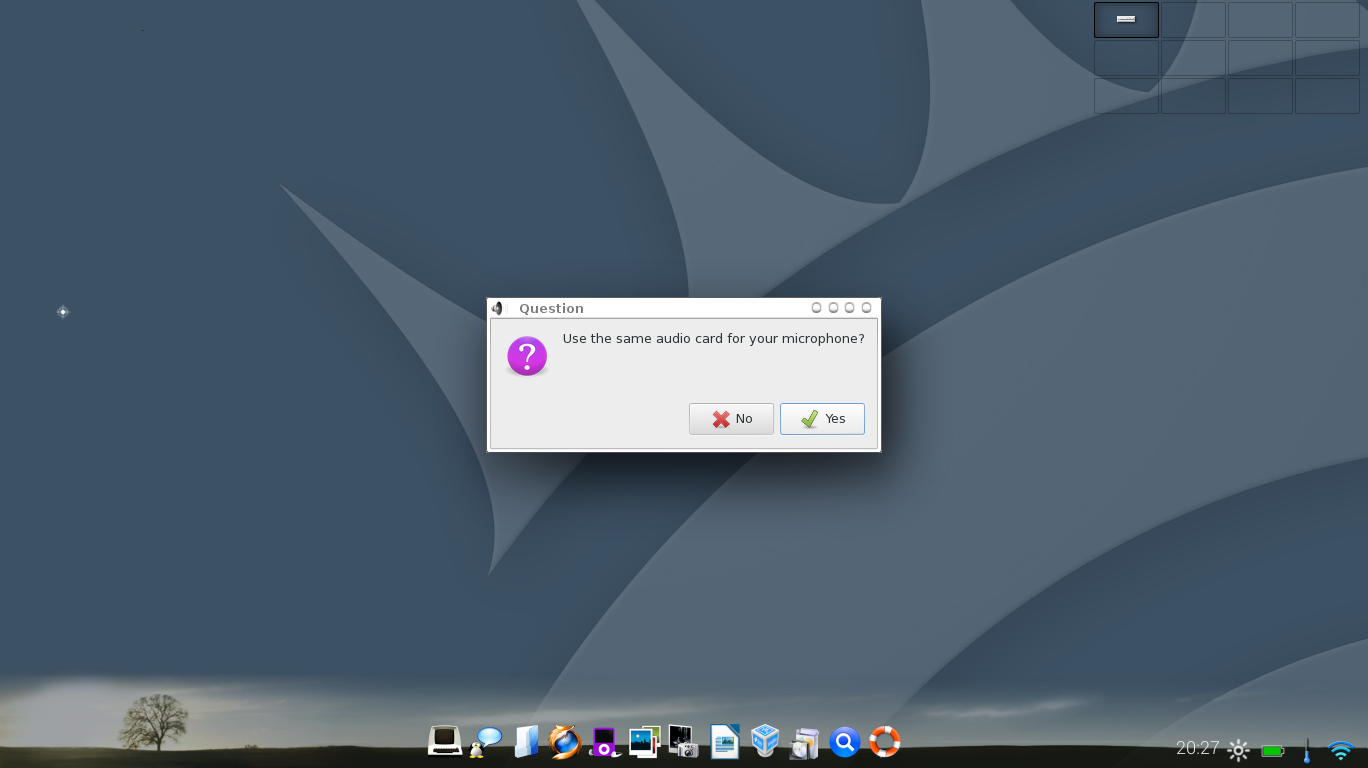
As for Elive 3, to enable the headset, one has to go to the sound configuration from the menu:


I do not run Steam on Elive, so I do not know if this process can work for that particular purpose.

 |
| Settings on Plasma--PCLinuxOS |
 |
| Settings on Plasma--Mageia 6 |
 |
| Settings on Plasma--OpenMandriva Lx 3 |
On Fedora 29, I had to change to Windowed screen in each game individually to be able to tick the box in Plasma like this:
 |
| Plasma settings for Steam game "Melody's Escape"--Fedora 29 |
As for Elive 3, to enable the headset, one has to go to the sound configuration from the menu:

 |
| After doing this, you might need to logout and log back in to listen |

 |
| Once completed the process, the audio players can send sound to the headset |
domingo, 24 de febrero de 2019
Fitting Fedora 29... For not all hats are the same
Yesterday, I wrote a post on how my Fedora 27 reached EOL and I had to upgrade to Fedora 29. So, I finished the download of the Fedora 29 KDE spin and, after creating a USB live medium, I started the installation expecting two main problems as a result:
1. A messed-up GRUB2
2. A fierce battle to get the printer working. Or the scanner. Or both, as I have a multifunction Epson XP 231 printer.
I have to say that this time the installer made me confused, in particular regarding the partitioning. I wanted to keep my home partition and it took me a while to figure out how anaconda does it, but I eventually managed.
The installation was quick after that and I rebooted.
Sure enough, I had problems with GRUB2. My OpenMandriva-controlled GRUB2 started, but when I selected Fedora, it tried to locate my old Fedora 27 and obviously could not boot. "No problem," I thought. "I simply boot OpenMandriva, refresh the GRUB2 configuration, and then boot Fedora."
But my expectation was met: Fedora messed up OpenMandriva and it performed two checks that lasted 1:30 minute each...
 After the delay, I used GRUB customizer and could boot Fedora 29 KDE. The OS was responsive and my personal settings were kept (since I used my old home partition), but one needs to do several things before the fresh install of Fedora becomes completely functional. Otherwise, you get something very promising, but somehow weird, like Indiana Jones using a top hat.
This post by Mehedi Hasan helped me a lot. I first installed the updates with su, my root password and then dnf upgrade. That took a while because there were many packages.
Next, I enabled the RPM Fusion repos. Again, after su and the root password, I pasted this text on the terminal:
Next, I installed essential programs:
dnf install vlc
dnf install libreoffice
dnf install wine
dnf install steam
dnf install gimp
The real challenge was to enable the printer and the scanner, as I had predicted. The printer driver installed without any problem, but I could not enable the printer because of lack of privileges. I solved that granting my user administration privileges.
The old Fedora 27 drivers for the scanner complained about missing dependencies, so I had to get this iscan bundle. Then, I remembered that Megatotoro had a post on how to enable the scanner here. That did the trick. Thanks, brother!!!
With that, Fedora 29 KDE was in a perfect state for me. Yay!
1. A messed-up GRUB2
2. A fierce battle to get the printer working. Or the scanner. Or both, as I have a multifunction Epson XP 231 printer.
I have to say that this time the installer made me confused, in particular regarding the partitioning. I wanted to keep my home partition and it took me a while to figure out how anaconda does it, but I eventually managed.
The installation was quick after that and I rebooted.
Sure enough, I had problems with GRUB2. My OpenMandriva-controlled GRUB2 started, but when I selected Fedora, it tried to locate my old Fedora 27 and obviously could not boot. "No problem," I thought. "I simply boot OpenMandriva, refresh the GRUB2 configuration, and then boot Fedora."
But my expectation was met: Fedora messed up OpenMandriva and it performed two checks that lasted 1:30 minute each...
 After the delay, I used GRUB customizer and could boot Fedora 29 KDE. The OS was responsive and my personal settings were kept (since I used my old home partition), but one needs to do several things before the fresh install of Fedora becomes completely functional. Otherwise, you get something very promising, but somehow weird, like Indiana Jones using a top hat.
This post by Mehedi Hasan helped me a lot. I first installed the updates with su, my root password and then dnf upgrade. That took a while because there were many packages.
Next, I enabled the RPM Fusion repos. Again, after su and the root password, I pasted this text on the terminal:
dnf install --nogpgcheck http://download1.rpmfusion.org/free/fedora/rpmfusion-free-release-29.noarch.rpm
dnf install --nogpgcheck http://download1.rpmfusion.org/nonfree/fedora/rpmfusion-nonfree-release-29.noarch.rpm
Next, I installed essential programs:
dnf install vlc
dnf install libreoffice
dnf install wine
dnf install steam
dnf install gimp
The real challenge was to enable the printer and the scanner, as I had predicted. The printer driver installed without any problem, but I could not enable the printer because of lack of privileges. I solved that granting my user administration privileges.
The old Fedora 27 drivers for the scanner complained about missing dependencies, so I had to get this iscan bundle. Then, I remembered that Megatotoro had a post on how to enable the scanner here. That did the trick. Thanks, brother!!!
With that, Fedora 29 KDE was in a perfect state for me. Yay!
sábado, 23 de febrero de 2019
Last minute shopping... I need a new Fedora!
Linux has become really stable. I remember that, when I migrated, I waited for the two yearly Mandriva releases. Then, it was for the yearly releases of Mageia and OpenMandriva. But releases have been slowing down. While Mageia and my daughter had pretty much the same age at first, my child will be 9 this year and Mageia is not 7 yet.
PCLinuxOS has to be updated frequently and PicarOS Diego and Elive are special. I once updated PicarOS and the result was a major disaster: it became a weird Minino spin. Elive took more than 5 years to move from 2 to 3, but it's awesome.
And then, there's Fedora.
I installed Fedora 25 as an experiment and upgraded to 26 and 27. But then I became lazy and lost track of its development because, once that everything worked the way I needed, the thought of installing the new distro releases went to the back on my brain.
However, today I tried to upgrade the Fedora packages and all I got was a message saying that my distro was up-to-date, which I immediately suspected because Fedora releases upgrades quite frequently, just as PCLOS.
So, I went online and read that Fedora 27 had reached EOL on November 30, 2018... Three months ago!
It goes without saying that I have to download the ISO and install it before the start of the new semester. I am on it, getting the Fedora 29 KDE spin. Darn, I feel like that client that rushes into the store in the very last minute before it closes!
Well, at least I know that Fedora is changing the logo :P

PCLinuxOS has to be updated frequently and PicarOS Diego and Elive are special. I once updated PicarOS and the result was a major disaster: it became a weird Minino spin. Elive took more than 5 years to move from 2 to 3, but it's awesome.
And then, there's Fedora.
I installed Fedora 25 as an experiment and upgraded to 26 and 27. But then I became lazy and lost track of its development because, once that everything worked the way I needed, the thought of installing the new distro releases went to the back on my brain.
However, today I tried to upgrade the Fedora packages and all I got was a message saying that my distro was up-to-date, which I immediately suspected because Fedora releases upgrades quite frequently, just as PCLOS.
So, I went online and read that Fedora 27 had reached EOL on November 30, 2018... Three months ago!
It goes without saying that I have to download the ISO and install it before the start of the new semester. I am on it, getting the Fedora 29 KDE spin. Darn, I feel like that client that rushes into the store in the very last minute before it closes!
Well, at least I know that Fedora is changing the logo :P

viernes, 1 de febrero de 2019
The Banner of Death!
Google+ greeted me with this banner.

I guess that says a lot about how all the campaigns to preserve the social network fared...

I guess that says a lot about how all the campaigns to preserve the social network fared...
jueves, 17 de enero de 2019
On Facebook
I came across this article today. With everything that is happening with social media today, one really thinks.
G+ is about to disappear and many users are going either to Facebook or to MeWe...
G+ is about to disappear and many users are going either to Facebook or to MeWe...
lunes, 31 de diciembre de 2018
Happy 2019!
2018 brought a lot of changes. Some of them were surprising, some others produced grief. It was a bumpy ride, I would say.
The new year is about to begin here and I want to collect some predictions in the Linux world for these coming 365 days.
From OMG!Ubuntu!
From Linux Journal
From Network World
Let's see how it goes.
Whatever it is...
Happy 2019!
The new year is about to begin here and I want to collect some predictions in the Linux world for these coming 365 days.
From OMG!Ubuntu!
From Linux Journal
From Network World
Let's see how it goes.
Whatever it is...
Happy 2019!
sábado, 29 de diciembre de 2018
Melody's Escape, An Entertaining Game
Megatotoro gave me a nice gift today: it's a Steam game titled Melody's Escape.

This is a simple time-killer in which you have to control Melody as she runs and avoids obstacles, but those obstacles are created according to a given music track.
This is a simple idea that combines the coordination of those dancing games in which you have to step on a direction arrow while the tune is played, but it has two nice features. The first one is that you can change the character and environment. The second one is that you can play to your own favorite music!
Thanks, Megatotoro!

This is a simple time-killer in which you have to control Melody as she runs and avoids obstacles, but those obstacles are created according to a given music track.
This is a simple idea that combines the coordination of those dancing games in which you have to step on a direction arrow while the tune is played, but it has two nice features. The first one is that you can change the character and environment. The second one is that you can play to your own favorite music!
 |
| Go, Yandere-chan! |
 |
| Regular game, right Mordecai? |
 |
| Alice Angel, from Bendy and the Ink Machine |
Thanks, Megatotoro!
jueves, 27 de diciembre de 2018
On Planned Cellphone Obsolescence
 |
| R.I.P. Blu Studio M HD... Was your death intended? |
The suspicion was inevitable: is this a confirmation that cellphones are somehow built to fail when the two-year lifespan is reached?
I know that most experts agree on the fact that it is not that the electronic components of the phone are designed to fail, but it is the battery that dies and causes the problems. That might be true, for the problems with my phone started when I noticed that the battery ran out of juice a lot faster than usual.
However, there is a detail: I specifically bought this kind of cellphone because of its manually-replaceable battery, which, in theory, extends the lifespan of the device. Except that today it is practically impossible to find a spare battery.
The lack of spares suggests that the industry is actually not interested on "repairability."
Buying a replacement for my dying phone in December is not an easy task: I only want a fairly cheap phone that can run my jogging apps and where I can check my email.
But most phones come with more powerful processors and more memory, all of which makes phones over-qualified for my personal use and, above all, more expensive.
Predictably, the new models cannot use the same batteries from previous models because the former require more power and, let us not forget, most phones today come with a non-removable battery.
Say what you may, but I do believe in cellphone planned obsolescence.
miércoles, 26 de diciembre de 2018
Well done, Elive!
Three days ago, DistroWatch announced that Elive had received an update. Although it is not an alpha version, I wanted to save it for my alpha testing this coming weekend.
However, after trying Netflix on Elive to update my previous post, I decided to update the packages to see what happened.
The process finished without any issue, so I wondered if I had received the aesthetic improvements that the DistroWatch post talks about, in particular " wallpaper - dynamically changes depending of the hour of the day, looking more magical and nicer for your eyes, and it also includes a hidden surprise for Christmas."
And, sure enough, I was surprised!
When I closed Firefox, which takes all the screen, I saw this:
I quickly switched to my other wallpapers to see if they had been removed or affected negatively in any way by the change. As they were fine, I went back to the dynamic wallpaper and found the old morning version. When I was asking myself if something had gone wrong, my eye caught an iconic figure moving from one side of the screen to the other:

Those details really make me want to turn my computer on despite the fact that I am on vacations. Truly, Elive is a great Linux distro, both concerning performance and eye candy.
However, after trying Netflix on Elive to update my previous post, I decided to update the packages to see what happened.
The process finished without any issue, so I wondered if I had received the aesthetic improvements that the DistroWatch post talks about, in particular " wallpaper - dynamically changes depending of the hour of the day, looking more magical and nicer for your eyes, and it also includes a hidden surprise for Christmas."
And, sure enough, I was surprised!
When I closed Firefox, which takes all the screen, I saw this:
 |
| Night time live wallpaper! The stars twinkle and the galaxy fades in and out. |

 | ||||||||||||||||||||||||||||||||||||||||||||||||||
| Santa's sleigh cruising my screen! |
Those details really make me want to turn my computer on despite the fact that I am on vacations. Truly, Elive is a great Linux distro, both concerning performance and eye candy.
Suscribirse a:
Entradas (Atom)
-
 A few days ago, thanks to one student, I realized that something funny was happening with my Linux netbook. He said that it was weird that I...
 -
 That's right. My desktop, which runs Windows, is infected and I blame Linux. As it normally happens in these cases, this new infection ...