It's no secret; Mandriva S.A. faced difficult times and improving the company's poor interaction with the community is the latest goal they have established. In the meantime, developers, users, and forum admins have gone (Farewell, Germ, and thanks for all of your work!).
As a Mandriva user, I am concerned because I would not like this beautiful distro to disappear. However, I haven't heard of a new Mandriva release soon. Mageia and ROSA, the two divergent lines of the continuity of Mandriva Linux, are buzzing with activity. For the ones who are not informed, while Mageia 1 kept the line of Mandriva 2010.2, ROSA is intending to keep the line of Mandriva Desktop 2011.
When Mageia 2 Beta 3 made its appearance in the Linux landscape, I tested it and was satisfied by its new look and use of KDE. In addition, the Japanese IME was working flawlessly, so I was very pleased there even if multimedia needed some tweaking to run properly.
ROSA, on the other hand, has unveiled its new release candidate of Marathon EE (EE is the version including non-free stuff, like the extinct Mandriva ONE). I downloaded, gave it a run in Live mode, and this is what I found:
ROSA presents some animated bars as the Live environment is becoming ready to launch. After a while of waiting (the wait was shorter than with Mandriva Desktop 2011, I must say), you are greeted by this desktop:
It is very responsive for a Live CD and the Spanish localization is very good. The most obvious change is the indicator of the KDE desktop. When you clic on the ROSA button, you see the well-too familiar ROSA launcher and SIMPLE WELCOME found also in Mandriva 2011:
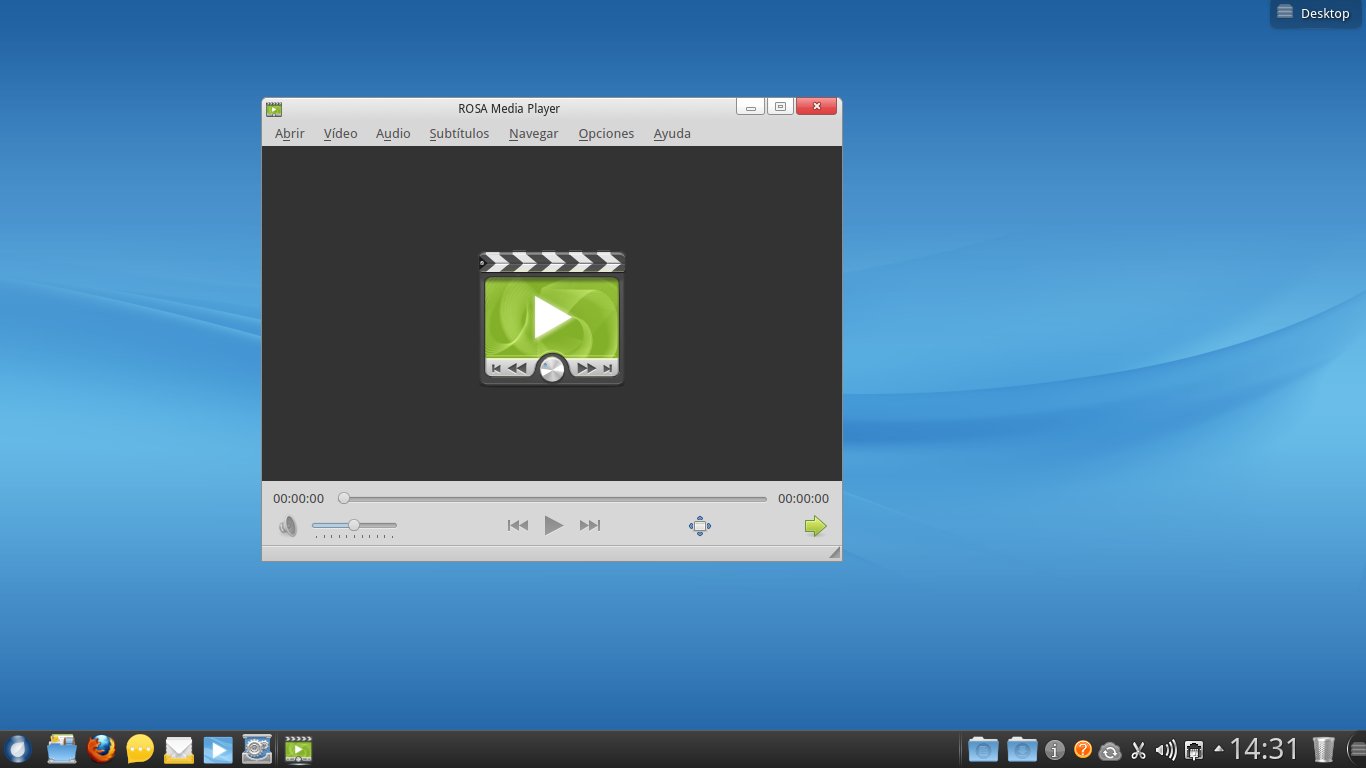
You have a ROSA sync icon, but I noticed the lack of software for a distro this size. I mean, you get a full LibreOffice suite, but in graphics or multimedia, the options are scarce. However, the ROSA player is promising:
The ROSA player works well with mpg and avi video but, when playing mp4's or flv's, there was no sound although it displayed the video. This was curious because YouTube worked fine out of the box.
ROSA Marathon EE also recognizes and mounts all the partitions on the hard drive in Live mode.
On a different note, the Mandriva influence is visible. For example, to configure the system, you type MCC (Mandriva Control Center), not RCC, and the ROSA control center opens:
You can also see the "M" in the icon ;-)
Overall, I think that this is a heavy system, but it is beautiful and usable for newbies. ROSa is beggining to capture some attention in the world of Linux, too, as seen by its quick moving up in the DistroWatch chart. I wonder if there is a ROSA community, though.
Now I will wait for the Mageia 2 RC to run a comparison.
A blog to compile what I have learned (and what I am learning) about Mandriva (and GNU/Linux in general) since 2009, when I migrated. Current distros I'm using: OpenMandriva Lx ROME 5.0, Mageia 9, MX 19, Manjaro 23.1, and Elive 3.
domingo, 29 de abril de 2012
domingo, 8 de abril de 2012
Ready to run? ROSA Marathon is here!
Yesterday, DistroWatch.com made it public that the beta 1 of ROSA Marathon is available for testing. This distro is a new fork of Mandriva.Interestingly, after one day of being released, ROSA is now in the 11th position, trailing Mageia (#8 in DistroWatch).
In the Mandriva forums users speculated that ROSA is the future of Mandriva. Since the company has not provided any fresh information (except for the "interesting news" without details in a forum post last March 8th), one cannot help but wonder.
Anyway, I downloaded the .iso and, sure enough, ROSA Marathon beta1 is like the twin sister of Mandriva Desktop 2011. Of course, this is no coincidence because the developers at ROSA Labs worked with the Mandriva devs to launch the last Mandriva product there is today. However, the resemblance is absolute: this distro's booting sequence shows no difference at all (well, the logo is different), ROSA has a ROSA Control Center that is identical to Mandriva's (the icon is even the same!) and, to be honest, the only different features I saw were:
1. More polished icons (ROSA logo as a launcher)
2. The ROSA player
I admit that I did not use it much because the interface is not my cup of tea, so I'll give it another run later.
viernes, 6 de abril de 2012
Ubuntu used in a video about viruses?

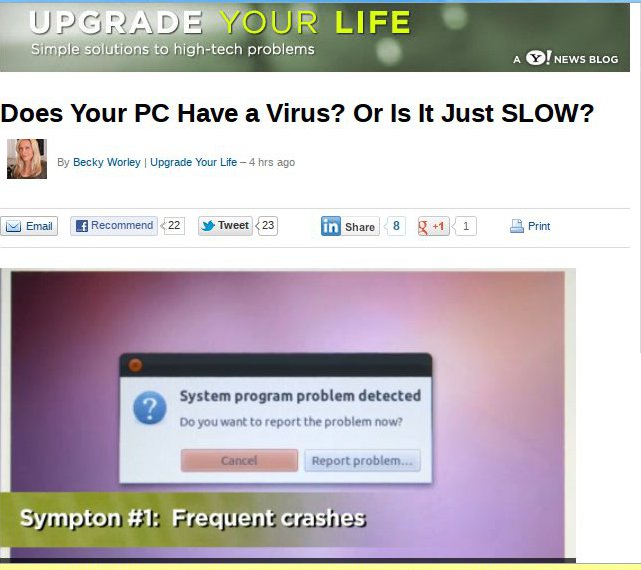
I was bored yesterday and this Yahoo! feature got my attention. It is about how tell if your "PC has a virus".
I might be mistaken, but the image they used to illustrate the first symptom of those annoying virus infections that plague Windows users seems to have come from... a computer running Ubuntu!
If that's the case and the illustration was used unknowingly, the reporter really needs to evaluate her sources.
However, if it was used intentionally, then "frequent crashes" in Ubuntu are being used as a misrepresentation of virus infections... For what purpose, I ask?
Judge it yourselves...
lunes, 2 de abril de 2012
Shibboleet syndrome
A very short time after both my brother and I migrated to Linux, we began experiencing the frustration of seeing the reality of the computer world: lazy technicians that charge to destroy your data, incompetent tech support staff who think that Linux is an anti-virus, unscrupulous companies that avoid their responsibilities and blame their helpless users by chanting their eternal mantra: "Your computer must be infected"...
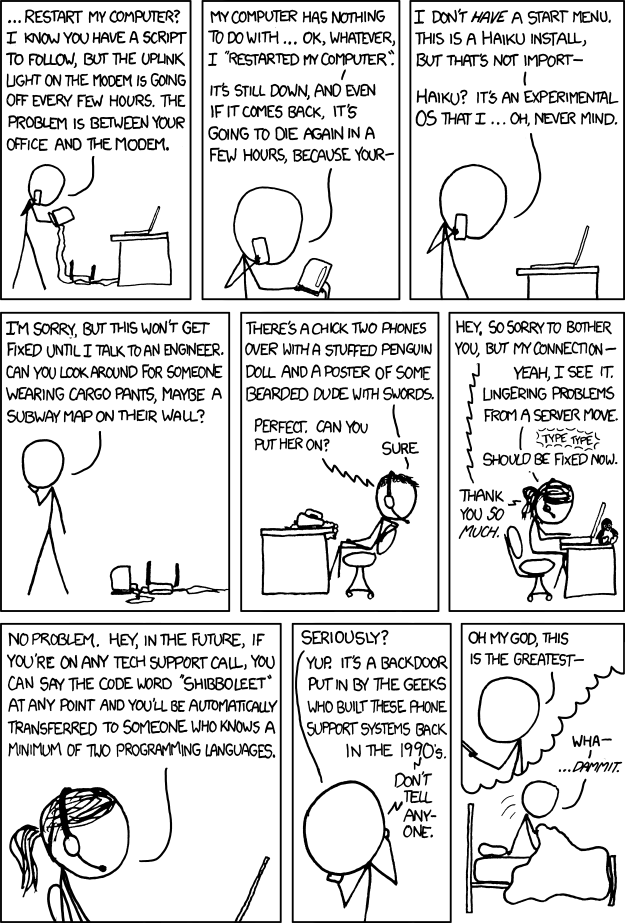
Particularly, dealing with tech support became so unproductive that, once you abandon the rosy all-computers-have-the-same-applications mirage, it is a lot more effective to learn to solve problems yourself unless, of course, you luckily find an individual who really knows about computers. I guess this comic strip summarizes it all.
It's xkcd #806, "Tech Support":

When I read it back then, I found it amusing because I could identify with the character having the problem with the modem. However, it was until yesterday that I could grasp the full impact of the comic strip; I had a dream that made me experience the level of frustration of the character.
In my dream, after running some updates for my Linux box, I was greeted by the most advanced desktop concept ever designed. Lean and mean, its jaw-dropping effects and futuristic features made me rub my eyes in disbelief: multiple workspaces with activities combined into "pages" of something called "Book", natural voice text synthesis, voice command input in multiple languages, an ultra-cute Foxkeh agent plasmoid retrieving Web pages....and the computer had bullet speed! As I was witnessing the system's amazing responsiveness, all that crossed my mind was "KDE really did it this time. I gotta show this to my brother!"
And there was this swirling, flashy 3D button in the middle of the desktop. When I clicked it, an alarm went off and a song started to play. Impressed, I thought, "Whoa! Cool! It's the same song I selected for the alarm I configured to wake u..."
No!!!!! I woke up. My palm went to my forehead: I was frustrated beyond words...
Shibboleet syndrome.
Particularly, dealing with tech support became so unproductive that, once you abandon the rosy all-computers-have-the-same-applications mirage, it is a lot more effective to learn to solve problems yourself unless, of course, you luckily find an individual who really knows about computers. I guess this comic strip summarizes it all.
It's xkcd #806, "Tech Support":

When I read it back then, I found it amusing because I could identify with the character having the problem with the modem. However, it was until yesterday that I could grasp the full impact of the comic strip; I had a dream that made me experience the level of frustration of the character.
In my dream, after running some updates for my Linux box, I was greeted by the most advanced desktop concept ever designed. Lean and mean, its jaw-dropping effects and futuristic features made me rub my eyes in disbelief: multiple workspaces with activities combined into "pages" of something called "Book", natural voice text synthesis, voice command input in multiple languages, an ultra-cute Foxkeh agent plasmoid retrieving Web pages....and the computer had bullet speed! As I was witnessing the system's amazing responsiveness, all that crossed my mind was "KDE really did it this time. I gotta show this to my brother!"
And there was this swirling, flashy 3D button in the middle of the desktop. When I clicked it, an alarm went off and a song started to play. Impressed, I thought, "Whoa! Cool! It's the same song I selected for the alarm I configured to wake u..."
No!!!!! I woke up. My palm went to my forehead: I was frustrated beyond words...
Shibboleet syndrome.
sábado, 24 de marzo de 2012
Observations on the growth of Linux use
Ah, statistics! How we love to deceive ourselves with them! Sometimes we tend to forget they are numbers applied to measure a reality, but they are affected by many variables. Therefore, statistics become a useful prediction, but a prediction is, ultimately, a guess nonetheless.
I am saying this because, since I migrated to Linux in 2009, I have been listening to Windows fanboys chanting that "according to Netmarketshare and StatCounter, Linux accounts for a skimpy 1% of the total market". And the funny thing is that they believe it!
My eyes, however, show me a different picture. When I migrated, the only Linux computer I ever saw was mine; I never spotted another computer running the Penguin OS in public. During the last two years, however, I've run into students who have Linux computers... but Netmarketshare has kept saying that Linux usage is 1% in 2009, 2010, 2011 and, yes, you guessed it, the first two months of 2012, too!
W3counter.com is another source that is frequently quoted to say that Linux represents a 1% marketshare. Notoriously, in 2009 it said Linux was 2% and then declined. Right now, W3counter is showing a gradual increase (1,67%).
It seems that Steve Ballmer, CEO of Microsoft, did not believe those numbers. Back in 2009, as he was giving a presentation to investors, he showed a slide that tells a different story. Wisely, he did not include any numbers (not to disclose critical information and scare investors
away, I presume), but the pie chart indicates that Microsoft either:
Who would you believe, then? I would go for Ballmer in this case: one would expect him to have more reliable data as he was addressing investors, don't you think?
If we take Ballmer's pie chart as reference, then Microsoft believed Linux had a marketshare of around 5% in 2009, judging from the graph proportion.
W3schools.com throws numbers onto the table that match Ballmer's pie chart (and his statements that Linux was worrisome): When Windows 7 retail was released (October 2009), W3schools' Linux count showed 4.2% marketshare and that number has kept going up to 5% in February 2012.
Another interesting observation is the behavior of Distrowatch. Yes, yes, I know that you are going to say that those numbers cannot be taken as an accurate measuring. Point well taken. However, Distrowatch count shows that either:
The latter scenario shows more interest in Linux which, in turn, suggests an increase in Linux use, especially when one pays attention to the last distro reported (#100). Let us see: in 2009 it was MOPSLinux (73 clicks). CD Linux took the spot in 2010 (86 clicks). For 2011, DreamStudio got the #100th position with 90 clicks. During the last three months of 2012, that same position belongs to LFS, with 131 visits.
That means that the last position in Distrowatch jumped from a two-digit number to a three-digit one. If we take that merely as an indication of interest in Linux, then it has increased in a 55.6%.
This matches the reality I see more accurately, the same one that Ballmer inadvertently described in 2009. One wonders what his numbers will show today.
I am saying this because, since I migrated to Linux in 2009, I have been listening to Windows fanboys chanting that "according to Netmarketshare and StatCounter, Linux accounts for a skimpy 1% of the total market". And the funny thing is that they believe it!
My eyes, however, show me a different picture. When I migrated, the only Linux computer I ever saw was mine; I never spotted another computer running the Penguin OS in public. During the last two years, however, I've run into students who have Linux computers... but Netmarketshare has kept saying that Linux usage is 1% in 2009, 2010, 2011 and, yes, you guessed it, the first two months of 2012, too!
W3counter.com is another source that is frequently quoted to say that Linux represents a 1% marketshare. Notoriously, in 2009 it said Linux was 2% and then declined. Right now, W3counter is showing a gradual increase (1,67%).
It seems that Steve Ballmer, CEO of Microsoft, did not believe those numbers. Back in 2009, as he was giving a presentation to investors, he showed a slide that tells a different story. Wisely, he did not include any numbers (not to disclose critical information and scare investors
away, I presume), but the pie chart indicates that Microsoft either:- Tried to minimize Apple (the shares of "Apple" and Linux are virtually identical)
- Believed Linux accounts for more than the never-changing 1% that Netmarketshare and StatCounter keep measuring since 2009.
Who would you believe, then? I would go for Ballmer in this case: one would expect him to have more reliable data as he was addressing investors, don't you think?
If we take Ballmer's pie chart as reference, then Microsoft believed Linux had a marketshare of around 5% in 2009, judging from the graph proportion.
W3schools.com throws numbers onto the table that match Ballmer's pie chart (and his statements that Linux was worrisome): When Windows 7 retail was released (October 2009), W3schools' Linux count showed 4.2% marketshare and that number has kept going up to 5% in February 2012.
Another interesting observation is the behavior of Distrowatch. Yes, yes, I know that you are going to say that those numbers cannot be taken as an accurate measuring. Point well taken. However, Distrowatch count shows that either:
- The same group of Linux users is keeping track of distros more closely (visiting distro pages crazily and bumping up the count), or
- More people are actually clicking on distro pages.
The latter scenario shows more interest in Linux which, in turn, suggests an increase in Linux use, especially when one pays attention to the last distro reported (#100). Let us see: in 2009 it was MOPSLinux (73 clicks). CD Linux took the spot in 2010 (86 clicks). For 2011, DreamStudio got the #100th position with 90 clicks. During the last three months of 2012, that same position belongs to LFS, with 131 visits.
That means that the last position in Distrowatch jumped from a two-digit number to a three-digit one. If we take that merely as an indication of interest in Linux, then it has increased in a 55.6%.
This matches the reality I see more accurately, the same one that Ballmer inadvertently described in 2009. One wonders what his numbers will show today.
sábado, 17 de marzo de 2012
Some reflections on Mageia 2 Beta 2
As a non-technical user of Linux, and after reading several posts about the battle between developers and users who feel neglected by them, I could not prevent myself from worrying a bit about the soon-to-come release of Mageia 2. You know, maybe Mageia also jumped on board that train that takes you to DumbOSland, where you "use-your-computer-as-if-it-were-a-cellphone".So, I downloaded the beta2 to have a preview of what Mageia offers to users of Linux who are not computer gurus by any standard, but who like computers to behave as what they are.
DISCLAIMER: This is not a technical review, so I'm not getting into codecs, Flash, boot-time, and the like. As a simple computer user, I wanted to check on the progress made by Mageia and I saw both positive points and negative ones. This is what I found on the negative side:
1. The artwork needs some, er, work!

I am inclined into thinking that OSs must keep a balance between efficiency and beauty. While I do not find myself necessarily annoyed by the color scheme or login screens of Mageia, I do believe that lack of consistency might make potential users to refrain from using a system because simple users, when seeing an inconsistency in the booting process, tend to think of it as "a problem". The graphical screen of Mageia 2 Beta 2 overlaps the text screen and it looks strange. Of course, that is not going to make a computer blow up, but still...
2. A hideous bug crawls through Mageia Control Center/ RPMDrake

Although the installation was smooth, when I opened Mageia Control Center to start adding programs, it told me that RPMdrake had to be updated. That is normal, so I marked some packages for install and waited.
The installation was successful and so was the updating of RPMdrake. The latter was the problem: after the updating, RPMdrake became unusable, which prevents you from performing any further software install operations.
Now, this is what I really call a problem. I presently ignore if it is a localized issue or many users experienced it, but this is not good. I tried three different combinations and all of them led me to the same dead end:
a. Install Mageia, select no upgrades, refresh repos (leaving DVD), install software from MCC=locked RPM db
b. Install Mageia, select upgrades, refresh and select some additional repos, install software from MCC=locked RPM db
c. Install Mageia, select no upgrades, refresh repos (unselecting DVD and selecting some additional repos), install software from MCC=locked RPM db
However, this worked:
Install Mageia, select no upgrades, refresh repos (unselecting DVD and keeping the default active), install software from MCC. I suppose this problem is going to be taken care of with the RC.
3. Japanese IME with iBus: Dekiruka, dekinaika?
This is perhaps the most technical requirement I have for selecting an OS: I need a free and efficient way to write in Japanese. There are many functionalities I can live without (games included), but my computer has to accept Japanese character input.
Mageia 1 Beta2 astonished me when I saw that iBus worked flawlessly out of the box, something I could never achieve in Mandriva 2010 regardless of all my efforts (iBus works perfectly in Mandriva 2011, though).
Since Mageia 1 Live CD removed this functionality (I must use SCIM for Japanese IME with that version of Mageia), I was a bit concerned of whether or not iBus will work in Mageia 2. I tried the beta 1 and, to my disappointment, although iBus seemed to be activated, all the languages were shown in light gray, the "conventional" color for unavailable features in a menu.
iBus in Mageia 2 Beta 2 showed the same. However, I discovered that, although they were displayed in a lighter color, if you click on the arrow preceding each language, a tree opens and you see the possibilities... Wheeee! My bad, really. After my battle with MCC, I downloaded all the packages to get Japanese working (Anthy, ibus-anthy, Japanese font) and tried iBus. It works... sort of.
Now, although you see the ibus keyboar in the taskbar, you must restart it to get Anthy running. And you must install the java packages for LibreOffice, too. Interestingly, iBus works in LibreOffice even if you do not uninstall the Libreoffice-kde package. Another issue: it does not seem to work with Firefox.Mageia 2 beta 2 で、日本語のIME、できるか、できないか?できそう。
----------------------------------------------------------------------------------------------------------
On the other hand, Mageia 2 Beta 2 brings onto the table some tempting features for simple computer users like me:
1. New KDE
I really like the way in which Mageia 2 is working with KDE 4.8.1. Let me say this and, please, computer experts, do not feel offended. I simply do not care if KDE is a resource hog or not. I mean, KDE runs perfectly on my 2GB RAM, 500GB HD, even if I have several programs open (including Firefox with 6 tabs). It also looks beautiful with all the eye candy and plasma widgets. People can get systems with twice the horsepower of mine to run another OS that requires a ridiculous amount of resources and they are happy that way. So, to be honest, I find KDE's demands reasonable (again, I am a simple computer user, not a technical expert). Stability? Well, I haven't experienced a single KDE crash in a very long, long time. Yes, maybe it's because I do not use each and every KDE application, but I use the ones I find indispensable. That being said, I think that the prize KDE obtained was well deserved and using it is fun.By the way, now the bottom panel marks with indicators the programs that are active and it also offers you an instant full-screen preview of the applications that are running. Some people I know are going to be crazy about these new features...
2. A satisfactory assortment of programs
Mageia 2 Beta2 packs LibreOffice 3.5.1.2, KOrganizer (I cannot live without it!) Okular (another gem), Scribus, Amarok 2.5.0, which nows incorporates the Amazon Store... I don't care because it works in some countries and mine is not included), Kdenlive, the players Dragon and Totem, and Gimp 2.7.4 with its new "export as" instead of "save as" dialog and image transformation tools.
3. Solid translations
As a Linux user, I cannot emphasize this point enough. Linux distros that provide only a couple of languages or inconsistent translations might not realize it, but they are reducing their possibility of adoption. Not all computer users speak English.
I believe that Mageia wants to offer a nice usability/freedom blend. Yes, I know that many Linux distros use the same motto, but they do not deliver; some say "We are the easiest computer experience", but then they switch your desktop for something you had never seen before and you are stuck with a desktop that that you simply don't understand. Mageia developers seem to understand that non-technical computer users need an OS that works with them, not against them. Thus, instead of "dumbifying" the user interface to the maximum, which is rather popular lately, they are following KDE's progress while keeping the same installation process. For computer users who lack technical training, that is certainly the right approach: I can follow the same steps and obtain a familiar, more polished desktop in the end. I can use it in my own language; it has the appropriate tools, and it requires little effort to use as I am not expected to relearn everything.
...A desktop that tells me I'm using a computer, not a gigantic cellphone. Thank you, Mageia!
miércoles, 7 de marzo de 2012
Not everything is happiness in the world of Linux
Before you start reading this post, let me say upfront that you will not find any complaints about technical flaws of Linux here. I want to write about events related to the human side of distributions, OK?
For people who enjoy tinkering with their computers, or those who like to see their systems perform actions that they never thought were possible, the freedom of Linux provides satisfactions, amazement, and joy. For example, KDE developers have a legitimate reason to celebrate because their efforts were acknowledged with the award of Best Desktop of 2011.
However, not everything is happiness in the world of Linux. Preceding KDE's award, the first trimester of this year was hit by three sad incidents concerning some notorious KDE distros: PCLinuxOS, Pardus, and Mandriva.
PCLinuxOS
Although you can use other DEs with PCLOS, it is eminently a KDE system that you can rely on. I have been using it both in a desktop and a laptop computer since version 2011.6 and I am completely satisfied by its performance.
User satisfaction is not a coincidence. Texstar, the founder of PCLinuxOS, puts a lot of effort in addressing bugs, polishing the distribution and, in short, making a Linux distro that you can count on for every possible task you want a computer to perform. In fact, he has worked so passionately that right now he is on a sick leave: he posted an announcement saying that doctors told him to rest.
This sad news, however, is not stopping PCLinuxOS. Wisely, while Texstar recovers, other prominent members of the community have taken the wheel.
Let us all wish Texstar a speedy recovery and a good ride to Old-Polack, Neal, and the others who are now in charge.
Pardus
It seems that Pardus was also hit during the first months of the year. Apparently, some developers are no longer with the project and Pardus 2011.2 was the last desktop version of the distribution. It is hard to confirm the information because the posts come in languages other than English.
So far, we know that there will be a Pardus workshop (March 23 &24) to decide on a roadmap. I hope everything goes well.
Mandriva
Mandriva's woes have not been new: the distro's year opened with a short post on Jan 17th stating the grim future of the Mandriva S.A. (the company), which was followed by a shorter post 10 days later.
There was a third post on the 30th promising more news to come in mid-February. Unfortunately, it is March 7th already and the company has not disclosed any information about its immediate future.
The common denominator here is that, in the world of Linux, developers and communities become more visible as they are: humans and groups of people who laugh, sweat, suffer, fight, succeed, and fail sometimes. Somehow, I feel honored to use an OS that reminds me of the people behind it instead of being used simply as a market good.
Let us see what news March brings...
For people who enjoy tinkering with their computers, or those who like to see their systems perform actions that they never thought were possible, the freedom of Linux provides satisfactions, amazement, and joy. For example, KDE developers have a legitimate reason to celebrate because their efforts were acknowledged with the award of Best Desktop of 2011.
However, not everything is happiness in the world of Linux. Preceding KDE's award, the first trimester of this year was hit by three sad incidents concerning some notorious KDE distros: PCLinuxOS, Pardus, and Mandriva.
PCLinuxOS
Although you can use other DEs with PCLOS, it is eminently a KDE system that you can rely on. I have been using it both in a desktop and a laptop computer since version 2011.6 and I am completely satisfied by its performance.
User satisfaction is not a coincidence. Texstar, the founder of PCLinuxOS, puts a lot of effort in addressing bugs, polishing the distribution and, in short, making a Linux distro that you can count on for every possible task you want a computer to perform. In fact, he has worked so passionately that right now he is on a sick leave: he posted an announcement saying that doctors told him to rest.
This sad news, however, is not stopping PCLinuxOS. Wisely, while Texstar recovers, other prominent members of the community have taken the wheel.
Let us all wish Texstar a speedy recovery and a good ride to Old-Polack, Neal, and the others who are now in charge.
Pardus
It seems that Pardus was also hit during the first months of the year. Apparently, some developers are no longer with the project and Pardus 2011.2 was the last desktop version of the distribution. It is hard to confirm the information because the posts come in languages other than English.
So far, we know that there will be a Pardus workshop (March 23 &24) to decide on a roadmap. I hope everything goes well.
Mandriva
Mandriva's woes have not been new: the distro's year opened with a short post on Jan 17th stating the grim future of the Mandriva S.A. (the company), which was followed by a shorter post 10 days later.
There was a third post on the 30th promising more news to come in mid-February. Unfortunately, it is March 7th already and the company has not disclosed any information about its immediate future.
The common denominator here is that, in the world of Linux, developers and communities become more visible as they are: humans and groups of people who laugh, sweat, suffer, fight, succeed, and fail sometimes. Somehow, I feel honored to use an OS that reminds me of the people behind it instead of being used simply as a market good.
Let us see what news March brings...
domingo, 26 de febrero de 2012
TEST: How to know if your computer license should be revoked
In this world of ours, where cyber-crime has taken a rise, people should be given a test to determine if they are capable to use a computer. After all, if licenses are given to operate machinery and vehicles, or to prove that a person has undergone training on a certain area, why is it that individuals who have no idea about how to use a computer without risking a network have indiscriminate access to one?Or even worse, why do those people who couldn't possibly care less about their own cyber-protection (or that of others) feel they have the right use a high-tech system they regard as some sort of an electric kettle and, in so doing, they compromise the safety of the Internet?
They should at least take a test with some easy questions to determine if it is less risky to have those people juggle with flame-throwers than it is having them turn on a computer. You know, like those tests that are published in magazines and newspapers to find out if you are cool, or if you are a nerd, or if one's habits indicate that one will eventually become a social menace.
Negligent computer users should take the test voluntarily in an attempt to assess their risk factor. The questions should be straight forward and, when in doubt, they should simply choose "yes".
I have collected some functional indicators from experiences with people around me:
Risk Level 1: Each affirmative answer = 1 pt.
1. You click on any link that you get by email as long as you recognize the name of the sender.
2. You plug in your USB drive and erase alerts without reading them because they bother you.
3. You can use your computer only because you wrote the steps to find your programs.
4. As soon as you see your computer acting funny, you call your techie friend to fix it for you.
5. Once the techie friend goes away, you generally blame him/her for all subsequent problems that your computer gives you.
Risk level 2: Each affirmative answer = 2 pts.
1. You keep forgetting to close your Facebook or email session.
2. You get an email reading "My girlfriend got your pictures and sent them to your spouse. You are dead meat. See pictures attached". So, you freak out and open the attachment, which happens to be a zip file where the compromising material is.
3. You strongly believe that there wouldn't exist any viruses online if everyone had the same antivirus and they kept it updated.
4. You open every powerpoint presentation that your relatives, friends, or colleagues send you, regardless of the fact that the powerpoint icon looks funny and the file is called "presentation.exe".
5. You download bundled software from the internet and install it to your Windows computer without even reading the different screens.
Risk level 3: Each affirmative answer = 3 pts.
1. You think that remembering passwords is too much trouble. Anyway, that's the job of the "computer people", not yours.
2. You never update the antivirus in your Windows computer because everyone else does. Anyway, that's also the job of the IT guys, not yours.
3. You strongly believe that your computer is OK as long as the system starts. All computers act funny, so it's not strange that yours also misbehaves from time to time.
4. You cannot run a specific program because a "moron" deleted the icon on the desktop.
5. You argue with people who do not support SOPA and PIPA, whom you call pirates. Then you go home and download a movie using this great Bitcomet thing that your teenage daughter/son installed to the home computer.
RESULTS:
From 1-5 points: You are like a drunk driver roaming cyber-roads. Your license should be suspended until you learn a bit about how not to be a danger for others and yourself online.
From 6-12 points: You might not know, but you became a legend. Yes, you are (in)famous because every computer you touch starts failing "mysteriously". Do the world a favor and stop using computers until you understand the risks. License suspended.
13-20 points: In your case, danger is like giving a four-year old a loaded Steyr TMP to play in the middle of a wedding reception. You HATE computers and it shows. Keep away from computers; they also HATE you. Only cyber-criminals love you. Your license to use computers should be revoked immediately.
21 points or more: I don't even know how to put it. You should seriously consider to lock yourself up in an anti-chip bubble, so that it will become difficult enough for you to interact with a computer in the future.
But you insist and want to use one of those wonderful machines? Then go get Linux ASAP. Only Linux can save us from you.
lunes, 20 de febrero de 2012
How to mount ISO images in Linux
Back in my Windows days, I was very happy to work with virtual CD drives thanks to Daemon tools. The ability to play games and watch videos without having to place the actual CD on the drive tray was like magic to me.Once I migrated to Linux, since the games I used to play were not supported, I forgot about mounting virtual drives.
Today, I learned how to mount ISO files in KDE: it's a real simply process that can be performed with the terminal or with a graphical tool.
Mounting an ISO file with Konsole
The first step is to create a directory which is going to be used to mount the ISO to. This is achieved by opening Konsole and, after typing SU and your root password, you type:
mkdir /media/any_name (any_name will be the directory).
Close the terminal and use Dolphin to find the directory where the ISO file you want to mount is. Let's suppose it is called "your-file.iso". Once in the appropriate directory, go to the menu in Dolphin and click on "tools". Then select "Open terminal". Once again, type SU and your password. Then type:
mount -t iso9660 -o loop your-file.iso /media/any_directory
And there you have it, Linux beginners! Your ISO will be mounted.
So you want to unmount the ISO? Well, in the terminal, as root, type:
umount /media/your-file.iso and then:
rd /media/any_directory (to erase the directory we created).
Notice that the command is umount, not uNmount.
Mounting an ISO file with Acetoneiso
If you think that the terminal is too much of a hassle, then you can use acetoneiso. Find it in your distribution repository and install it. Then, launch it from the menu and the first thing the program will do is ask you to select whether you use KDE, Gnome, or any other environment. After that, you yous have to select the file and click in mount or unmount. This program creates a folder called "virtual-drives", in which it makes numbered directories where your ISOs will be mounted to.
A notorious difference is that they are created in your home folder, not in root.
domingo, 5 de febrero de 2012
Scholarly work using Linux
I have not been able to post here lately because I received an invitation to publish a scholarly article and, therefore, I got busy writing. I worked passionately on this project, sometimes getting up early to gather sources before my one-year old daughter would get up. You know, once she gets up, I prefer to play with her ;-).The writing process went as usual. However, when I finished with the article, I remembered everything I did to complete my thesis back in the days in which I was an avid Windows user. I could not help it: I compared the way in which I worked then (with Windows XP) and how I do it now (with Linux powering my computer).
To be able to finish my thesis, I had to steal sleep hours; I would get up every day at 3AM for a month. My Windows computer helped me with the task: it would turn on by itself, load my thesis document, open my browser, and play a song to wake me up. Remember I am no computer guru. To achieve all that, I had to download several programs (and their corresponding cracks). No wonder my Windows box was always infected and throwing tantrums at me!
In Linux, I do not have to install anything for my computer to do all that: the OS includes all the functionalities I need. From KOrganizer, I get the computer to wake me up with a song and to launch Firefox and LibreOffice with my article without exposing my computer to any malware. I simply used the process for a song but selected "application/script" instead of "sound". Then I wrote libreoffice3.4 for "application" and added the path where the file was in "arguments".
But that's not all: Linux has a great tool for copying citations from PDFs: Okular. Its fabulous feature to select text from virtually any PDF, copy it, and paste it truly facilitates the process of adding citations to one's article. Even in the rare cases when it is not possible to get the selection as text, you can paste it as an image with Okular...simple and quick.
Oh, and the workspaces! They are so convenient; you can work without all the clutter. I kept a thesaurus in one desktop, the browser ready in another, some PDF sources in another, and my main document in another. This way, you just say good bye to the waste of time caused by the repetitive minimizing and maximizing of the wrong application.
Thus, when I hear all those silly claims of Linux not being ready for serious work, I chuckle. Waking up, doing research, formatting my sources, writing, proofreading... from nothing to completion, every step of the writing process was a lot more efficient thanks to Linux. I do not even have to worry about MS Office compatibility: the magazine accepts .odt files!
So, I finished this article pretty quickly. And the best part is that I did not have to sacrifice the time to play with my daughter.
lunes, 30 de enero de 2012
The satisfaction of an online course on Linux

My mother, who successfully migrated from Windows to Pardus GNU/Linux, is always alert trying to find news about FLOSS in our little country. Two weeks ago, she called me with information that seemed like a dream: a reputable University that promotes online learning was offering a course named "Linux OS".
To be honest, although I really wanted to register, I hesitated. After all, online learning is not fully developed here and the platforms are Windows based. Paying only to discover that you are barred out because the software that the institution uses is not Linux inclusive is, obviously, no fun at all. So, before registering, I decided to find as much as possible about the course program and the platform. My inquiries gave positive results; everything seemed suspiciously fine.
Could that be possible? This was the same institution in which, a short year ago, Megatotoro had a hard time with the online platform because of its poor support for Linux. How about if they assume that all the students interested in Linux work from a Windows computer? Was it safe to expect them to fully support Linux just now?
However, I did not want to miss the opportunity: this could very well be my first formal course on Linux. I migrated two years ago without even knowing what Linux was and I have been learning about this family of beautiful OSs in a rather empirical way ever since. Actually, this blog was my attempt to have a record of everything I learned... Yes, the student inside of me was begging me to register.
I did. The course on Linux will be both my first online course and my first Linux formal training.
Today, I submitted homework # 1 and got a bit scared with the proposed evaluating activities. What about the platform? It does support Linux! I accessed it using Firefox 9.01 and it worked like a charm. Megatotoro is my virtual classmate, by the way.
Kind readers of this humble blog, please wish us luck ;-)
Suscribirse a:
Entradas (Atom)
My First 12 Days with Mageia 10: How to enable repos with dnf5
Well, 12 days have passed since I migrated all of my desktop, laptop, and portable work system to Mageia 10. I have not used the work system...
-
A few days ago, thanks to one student, I realized that something funny was happening with my Linux netbook. He said that it was weird that I...
-
That's right. My desktop, which runs Windows, is infected and I blame Linux. As it normally happens in these cases, this new infection ...